
The Radley Test
A real workshop secret

I hated Kate, my editor, long before we ever met. I’m an indie author, which means I firmly believe editors exist for one single purpose: to meddle with every sentence I write and tear every piece apart, citing some vaguely superior literary nonsense while doing it.
To be fair, I later saw plenty of evidence to support this belief. Like the time Kate deleted three full pages from one of my manuscripts without blinking, adding nothing but a short note: “Whiny.” Or when she presented her own idea in a way that made it sound as if I’d come up with it myself. Classic. I later avenged with remarkable elegance by pushing her into a swimming pool, fully clothed. To this day, she still avoids standing too close to water when I’m around.
At our first meeting, I handed her the manuscript of Nothing Before Her. She asked for a week to read it. Perfect, I thought. Plenty of time to make a voodoo doll and stick a pin in it for every word she crossed out.
In the end, though, I chose a different method to tame Kate—and if you happen to have an editor of your own, I warmly recommend it, because it worked for me. When she showed up at my office a week later, I suggested we write a short story together: one sentence each, taking turns, in the so-called ‘Peter Radley style’—assuming such a thing even exists.
She agreed, fully aware that the result might turn into some kind of dadaist nonsense. We even made a deal never to publish the text—but promises are made to be broken, so here it is after all. The italicized sentences were written by Kate. The rest are mine.
——-
A Flutter of Wings
It was an April day, but it felt more like autumn than spring—and I had no idea what to do with myself. The city always felt too loud for this kind of mood, so I just sat over a cup of coffee that had gone cold long ago, trying to decide whether I should go somewhere or finally admit that there was nowhere to go.
It surprised me that I was bored, because that’s not like me—I always told my daughter that if she truly had no ideas left, she should count her teeth with her tongue. I ran my tongue along my teeth mechanically and realized that certain pieces of advice only work until you’re forced to take them seriously.
It very much seemed like if nothing happened, I would spend the entire day with kitchen-table philosophy, which I knew in advance would be more exhausting than mountain climbing. I stood up, put on my coat, and set off without a destination, because aimlessness is sometimes the only honest direction when everything else feels like an excuse.
In the stairwell, I passed the graffiti that read “Rot in hell, you piece of trash,” which usually annoyed me with its gratuitous vulgarity, but now somehow felt like a handhold on reality. There are sentences that don’t comfort you and don’t give direction, they’re just exactly where you are, and sometimes that means more than any clever thought.
Not that I had much chance for clever thoughts—the April autumn was wearing me down for some reason. I felt as if the weather itself were personally working against me, and that petty, insignificant conspiracy took a surprising amount of energy out of me.
Stepping out onto the street, it was oddly calming to realize I wasn’t alone in this mood: people and the world seemed to visibly hate each other. On the sidewalk, the faces drifting toward me carried the same tired, terse truce I had made with the day—we won’t cause any major damage, we’ll just somehow survive each other until evening.
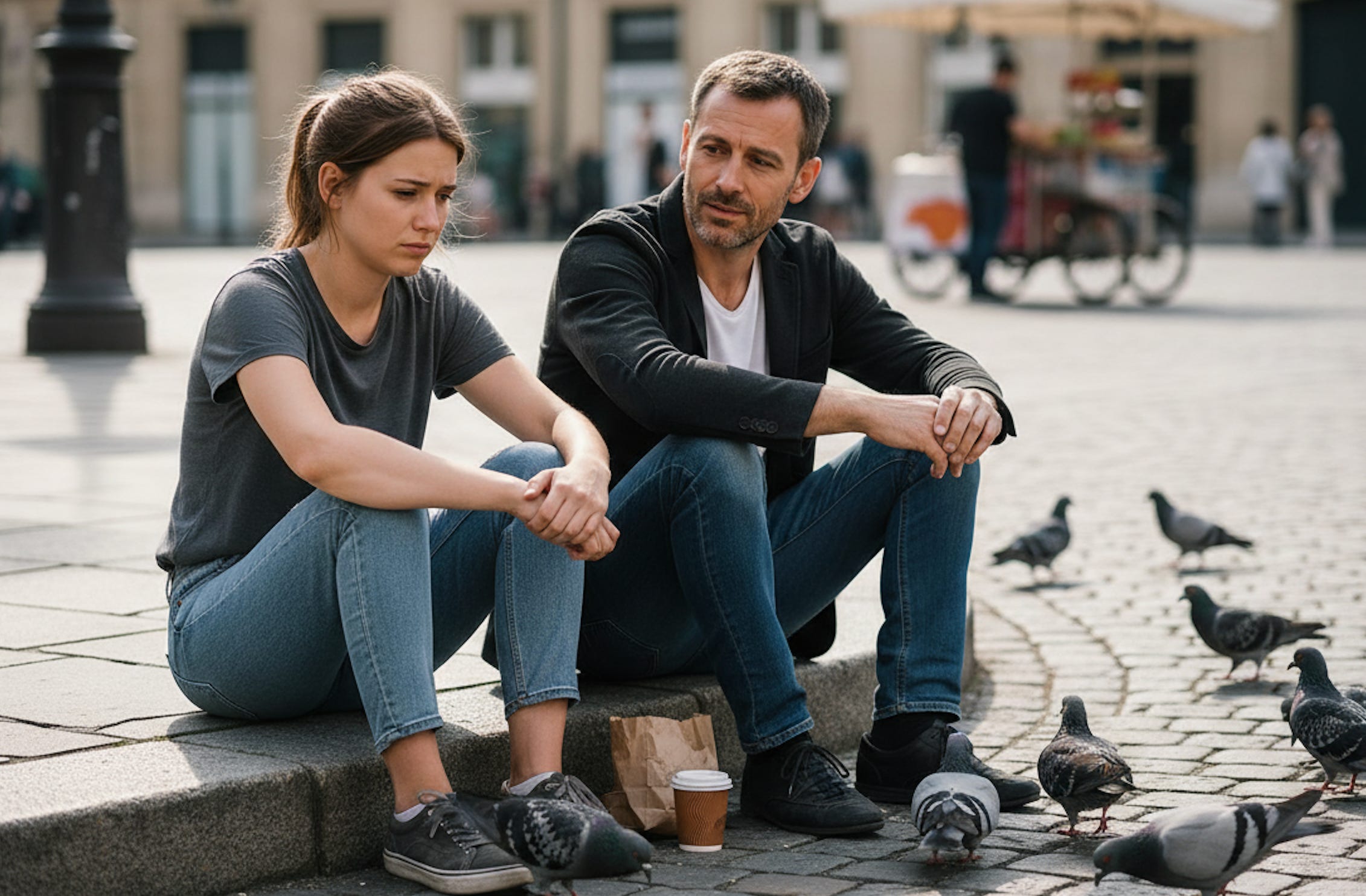
But unfortunately, life doesn’t work that way, and I realized this immediately when I saw the girl sitting on the curb. She wasn’t doing anything special, she was just sitting there sadly—and that made all my carefully constructed indifference painfully unusable.
The eternal problem: say something—or walk past without drawing attention. I stood a few steps away from her, knowing perfectly well that whichever decision I made, I’d spend the rest of the day wondering what would have happened if I’d chosen the other one.
It was a bit embarrassing to admit, but on any other day I would have walked past without a word. But the April autumn stubbornly stayed inside me and wouldn’t let me pretend this was just another moment without consequences.
I realized I must look pretty stupid standing next to a sad girl on a curb, wondering what the hell I should say to her. That realization actually helped, because once you already look stupid, the urge to look smart tends to disappear.
I sat down next to her without a single word. She didn’t look at me, but she shifted slightly in my direction, just enough to make it clear that she had noticed me and, for the moment, wasn’t telling me to fuck off.
For a while, we watched the pigeons wandering around the street in silence, then I said, “I think they’re plotting world domination.” Something very faint, barely noticeable flickered at the corner of her mouth, which could have been a smile—or maybe just the memory of one.
“Too stupid for that, aren’t they?” she asked quietly. “They’re not stupid,” I said, “just patient—and we tend to underestimate those who can afford to wait.”
After a long silence, she replied, “I waited too long.” I didn’t ask what for, because I had a feeling the answer would be too heavy to set down on the pavement.
She didn’t rush to continue either, instead she picked up a pebble and threw it toward the pigeons. The pebble missed, of course, but the pigeons still fluttered away, as if startled not by danger but by the sudden decision.
“Is it better now?” I asked. She shrugged and said, “It’s not worse.”
This wasn’t my first time sitting on a curb next to sad girls, so I suspected I wasn’t far off with the next question. “Did he leave?” I asked eventually.
“A banal story, right?” she asked back, sounding gruff but clearly angrier at herself than at me. “Actually, yes. But right now this is the most important thing for you, otherwise you wouldn’t be terrorizing pigeons.”
She finally laughed, briefly and unexpectedly, as if those two sentences were enough to let go of everything that had made her throw pebbles so determinedly.
“What are you, some kind of pigeon rescuer?” she asked, visibly startled by the thought of being too honest with a stranger.
“No,” I said, “more like a moment rescuer.”
“I hate moments,” she replied sharply.
“I do too,” I said, “it’s just that you only find out they matter when it’s already too late to hate them.”
“Do you often philosophize on curbs, or did you need me to turn into Aristotle?” she asked gruffly, though her eyes were already sparkling a little more brightly.
“No,” I smiled, “I’m too lazy for Aristotle. So I just sat down next to you at the right time to stop you from thinking, while I myself was thinking about how to convince a girl sitting on a curb to pull herself together before she catches a cold.”
She tilted her head and said, “That almost sounds like caring.”
“Not at all, I just don’t want to visit a complete stranger in the hospital.”
“Too bad,” she replied dryly, “I was just about to believe that sometimes people stay for no particular reason.”
“I’m still here, though I don’t think you need me.”
She looked at me very seriously for a moment, then said, “I don’t need you—I’m just glad you didn’t leave.” Stood up, smoothed her clothes, looked at me for a long time, and added, “Thanks, this is exactly what I needed right now.”
I watched her walk away along the sidewalk, and strangely enough, I didn’t wonder whether I’d ever see her again, but realized that for the first time that day, I didn’t feel completely useless.
——-
So that’s it. Contrary to my initial expectations, it turned out to be quite presentable. And did it work as an editor-taming method? I don’t know. But one thing is certain: some kind of chemistry does exist between us, since Kate and I have just finished our fourth book together. What’s more, she edits my Substack posts as well—this one included.
I assume she was especially pleased with the first sentence. 😀
(Drop dead, Radley. 🌷)