
The Clay Army
Absurd? No. Just a regular Tuesday.

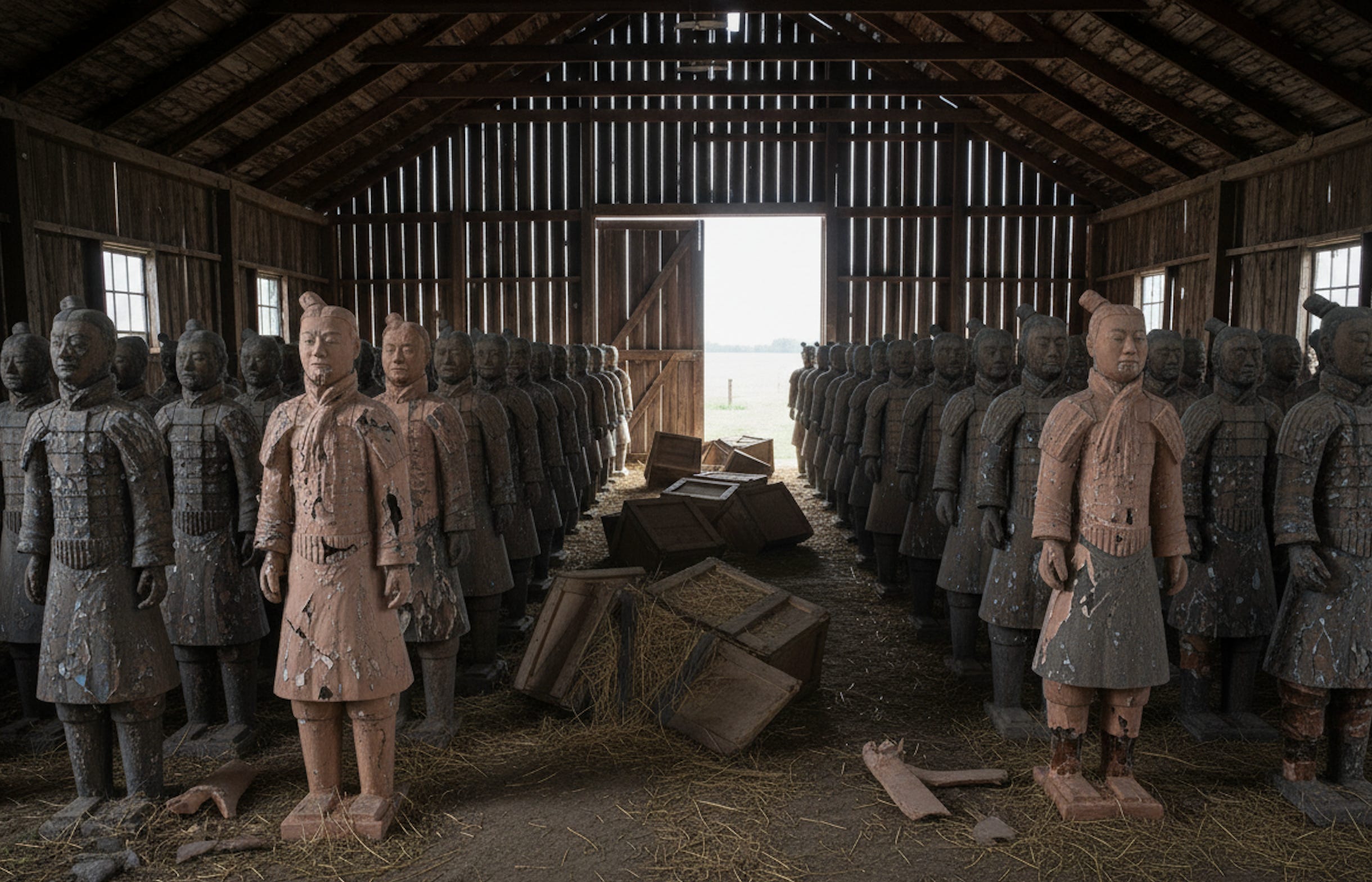
Somewhere around episode thirty, things started slipping into the realm of the surreal. That’s a good opening, right? Kate, my editor, always says the first sentence matters most. She once told me a story about Gabriel García Márquez, who—whenever one of his books appeared in a foreign language—had the opening sentence read aloud to him, just to hear whether it still sounded powerful enough. Not that I’m comparing myself to him. It just popped into my head.
But back to the surreal.
When my novel Nothing Before Her came out, a few people mentioned they’d be happy to read more stories from my years as a TV reporter. Well—this is one of the most memorable ones.
The setting is Central Europe, though not the glossy postcard version—rather a worn-down mini-region of sorts, made up of thirty-five settlements. Our task was to make a video about each of them: where they’d been ten years earlier, and where they had ended up now. Developments, investments, plans, dreams, that kind of thing.
Professionally, this wasn’t exactly a major challenge. Similar villages, similar stories—similar questions and images. Nothing out of the ordinary. My job was particularly easy, since I only handled the camera; the interviews were done by Martha, my partner in work and in life. We understood each other from half a word, so we knew exactly what to do if we wanted to escape a location reasonably quickly. Martha shot from the hip with her questions, and she also had that fortunate talent of looking genuinely interested while doing so, rather than like someone hearing the same story for the thirtieth time. So everything went perfectly smoothly.
Up to that point.
We arrived in the chosen village, seated the mayor behind his desk, clipped a microphone to him, I turned on the camera, and the conversation began.
“Mr. Mayor,” Martha started with a pleasant smile, “perhaps we could begin by talking about developments in healthcare provision.”
A faint look of confusion appeared on the mayor’s face, which we didn’t quite understand, since this really wasn’t a complicated question.
“I’d be happy to talk about that,” he finally said, “because a lot has indeed happened in this area. But unfortunately, you won’t be able to meet our doctor. Two months ago his wife died—who, as it turned out, also happened to be his psychiatric nurse—and since she’s no longer administering his medication, the doctor’s symptoms have intensified. Yesterday he was running around in front of the clinic, screaming and waving a scalpel, so the paramedics took him away in a straitjacket.”
I’ve been working as a reporter for over thirty years, so believe me when I say: that’s a fairly strong opening in what looked like a perfectly innocent interview. But Martha proved to be sufficiently battle-hardened, because without batting an eye, she moved on to the next question.
“Alright. Then let’s talk about developments in technical infrastructure.”
“Uhh…” This was starting badly. Very badly. And what followed did nothing to ease our fears. “Well, we’ve purchased quite a few pieces of equipment using grant funding—tractors, lawnmowers, and various other things. But… you won’t be able to meet the caretaker. You may remember that case in the neighboring village, where a drunken local was tied to a pub terrace railing with fishing line and froze to death overnight. Unfortunately, it turned out our caretaker was the mastermind behind the idea, so the police took him away this morning.”
I was genuinely relieved that I wasn’t the one asking the questions, because this allowed me to hide behind the camera and laugh in peace. Martha had the harder job of maintaining the seriousness of the situation. Fortunately, she was still in control—for now.
“Let’s move on,” she continued with a calm that was starting to look suspicious. “If I’m not mistaken, the church and the parish hall have also been renovated.”
If she thought this meant calmer waters, she was bitterly mistaken. This became immediately obvious as the mayor’s confusion deepened—if that was even possible.
“Yes… our church turned out very beautiful… But unfortunately, you won’t be able to meet the priest either. It came to light that during the renovation he embezzled not only the grant money, but also the donations from the collection box. He was arrested two days ago and is currently in pre-trial detention.”
From that moment on, Martha was the last anchor to whatever scraps of reality were still afloat. I, meanwhile, had crawled into the corner of the office and was quietly wheezing from suppressed laughter. But Martha was not made of the kind of wood that splinters easily.
“Well then, Mr. Mayor,” she said again, in a disturbingly composed tone, “it seems to me that there are only two possible explanations. Either we’ve accidentally entered an early development build of GTA V and are currently testing a software bug. Or you are, in fact, the mayor of Honduras, and you haven’t even begun to outline this year’s crime statistics.”
The mayor nodded sadly, like someone who fully understood that what he’d just said wasn’t easy to digest. And Martha, determined to salvage what could still be salvaged, pressed on mercilessly.
“So now, if you don’t mind, I would very respectfully like to ask: is there anything in this otherwise quite charming village that you could show us, which we could look at without the owner of the attraction being handcuffed by the police right in front of our eyes?”
I will never forget the mayor’s answer.
“Well… in that case, perhaps the most sensible thing would be to show you… the Clay Army.”
The face of my life partner remained perfectly motionless; only one eyebrow crept upward slightly, which in her case could be interpreted as the unmistakable sign of an impending cerebral hemorrhage. Meanwhile, I carefully scanned the office, as my growing conviction was that we had fallen victim to some kind of hidden-camera prank.
But the mayor seemed visibly cheered by his own idea. He jumped up from behind the desk and briskly headed for the door.
“Come with me.”
We followed him in our own car, just in case a quick escape became necessary. We soon left the village behind, which wasn’t much of an achievement, since the entire place consisted of maybe eight streets. We drove along unpaved roads, past rusting combine harvesters and dead cows lying by the roadside. It was starting to feel like we were voluntarily throwing ourselves into the clutches of a deranged serial killer. I glanced at Martha, and since she still appeared relatively calm, I asked her that if she alone survived this adventure, she should please tell my mother that I had fought heroically to the very last minute. She laughed—but her smile didn’t look entirely sincere.
After a long, aimless drive, we arrived at a ramshackle farm where any major Bruce Willis action scene could have been filmed without further set design. Following the mayor, we approached a door. The door swung open, and behind it stood… the Clay Army.
At least two hundred life-sized clay soldiers, each with a different face, uniform, and weapon. An unbelievable sight.
I rubbed my eyes, then my temples, and collapsed onto a broken crate. It wasn’t easy to speak.
“Mr. Mayor,” I finally said, in the most serious voice I could manage, “please think very carefully about your next answer. Because if these are real, we are taking at least one soldier with us, and we will have no choice but to leave you behind, tied up with a microphone cable.”
The mayor understood the bitter irony perfectly. With a wide grin, he sat down opposite me on another crate and began to explain.
“Of course they’re fake. They’re all made of plastic, actually.”
“I have to ask what exactly they’re doing here…”
“Yes, that’s entirely reasonable. And yes, these are replicas of Emperor Qin Shi Huang’s terracotta warriors. We have a Chinese man in the village who married a local woman. A real wheeler-dealer type—he’s traded in all kinds of things over the years. When these soldiers became fashionable, he had two hundred and fifty replicas made and rented them out for exhibitions, films, even birthday parties. Then the trend passed, and the soldiers have been stationed here ever since. For twenty years.”
The veil was lifted. Not so surreal after all, right? Still, it’s a decent story—especially considering we survived it.
Oh, and what ended up in the video?
Meadows and rooftops. Drone shots.