
Secret Diary
A Practical Guide to Surviving Peter Radley

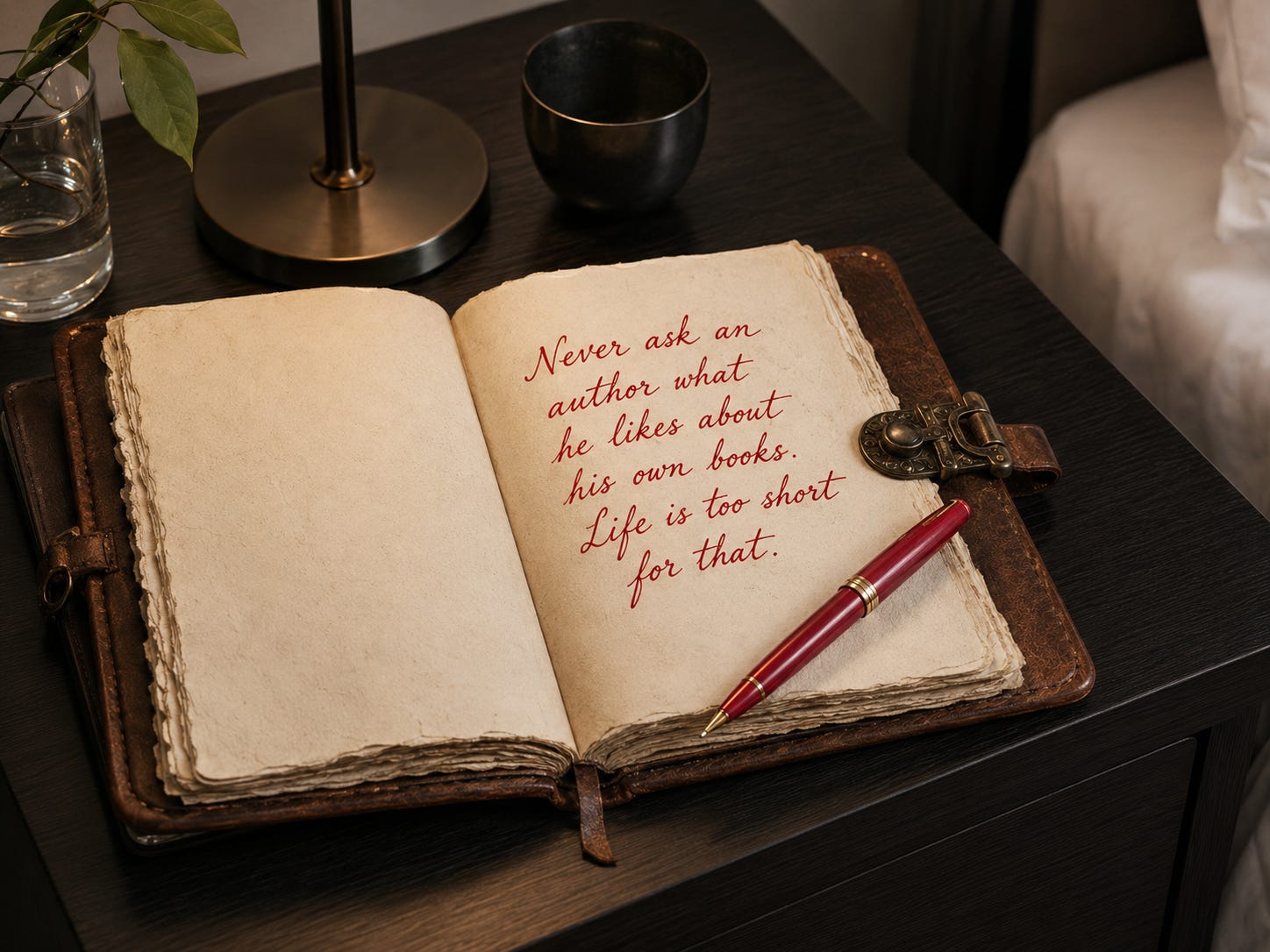
If I remember correctly, I already showed you an excerpt from my editor Kate’s diary, which she, with exemplary restraint, calls A Practical Guide to Surviving Peter Radley. The other day, I suggested to her that we might publish a few entries from that diary.
She said okay. She said it very quickly. Actually, suspiciously quickly.
I’m beginning to worry.
*****
Well, Radley… you have every reason to worry.
Basically, I am not the diary-writing type. I see quite enough text as it is, and after a certain amount of manuscript, a person begins to appreciate silence, blank pages, and those rare moments when nobody wants to “just quickly discuss an idea.”
Then I realized that if I occasionally jot down a few words about our work together, I will have something to look back on later, when everything begins collapsing on our heads with its usual punctuality.
So this is not really a diary.
It is more like mental health protection.
And, in extreme cases: evidence.
“Just an idea”
In Peter Radley’s terminology, the phrase “just an idea” never, under any circumstances, means just an idea. It is an early warning system. Like when the sea suddenly pulls back from the shore, the birds fall silent, and the more experienced locals have already started running uphill.
At that point, the seasoned editor makes coffee, locks the door, and checks whether there is enough oxygen in the room for the next three hours.
So the most important rule is this: when Peter Radley says, “I have an idea,” do not panic.
There will be plenty of time for that later.
“Let’s take a quick look”
With Radley, this is one of the most dangerous sentence openings. At first it sounds like a harmless remark, but in reality it is the first faint crack of a creative avalanche. What it roughly means is this: we are going to rearrange the entire emotional dynamic of the chapter, come up with three new subtitles, throw out two good sentences, rescue one bad one — and somehow, by the end, the text will still come together.
The phrase is especially dangerous in the evening, when I am already sitting half-asleep on the couch and the message arrives: “Should we take a quick look at this?”
No. We are not taking a quick look. We never take a quick look.
Especially not when the message also contains the phrase, “It’ll really only take five minutes.”
Notes to myself
(Radley must not see these)
Never ask an author what he likes about his own books. Life is too short for that.
Unfortunately, Radley is not stupid. This is particularly annoying in situations where, as an editor, one would like to fall back on the old, reliable method: gently, elegantly, almost invisibly selling one’s own ideas to the author as if they had actually sprung from his head.
With other authors, this works. Radley spotted it the second time. I saw it in his eyes: he immediately began thinking about some elegant and carefully measured revenge.
The next day, he pushed me into the swimming pool. I am still wet.Too much silence is always suspicious. At such times, Radley is usually writing an internal essay about how an accidental touch connects to the character’s childhood losses, the decline of European civilization, and a forgotten, rain-scented Tuesday afternoon.
Handwriting
A traditional and relatively advanced form of communication. Just not with Radley.
He practically has no handwriting. What he calls handwriting is what my cat scratches into the cutting board when she accidentally gets into the kitchen.
From time to time, Peter writes something down on a scrap of paper and puts it in front of me.
I cannot read it. I do not think he can either — he only remembers it because his memory is annoyingly good.
That is why we mostly communicate by text message. Which is also old-fashioned — almost charmingly museum-like.
But at least it is legible.
Red pen
Do not say this in Radley’s presence. He hates it.
And no matter how often I explain to him that the passages marked in red in his manuscript are not bad. Maybe they are just not strong. Or too sprawling. Or they ring false against the rest of the text.
Fine. They are bad.
From the first book we worked on together, I cut three entire pages. They were whiny. I will not show them to you, because Peter would be ashamed of himself. Naturally, he was mortally offended. He threw this at me: “Great. Maybe we should cut the whole book and publish blank pages with a white cover.”
Then, that evening, he sent me a text message: “Was it really whiny?”
I sent back a smiling emoji. You know the one. The one that can mean “everything is fine,” but can also mean “drop dead.”
Practical advice: in Peter Radley’s vicinity, the red pen should always be kept somewhere clearly visible.
Not necessarily so we can use it.
Sometimes it is enough for him to know it is there.
Being offended
Between Radley and me, there are two main types of being offended.
Mine. And his.
Mine is usually quieter. This, of course, does not mean it is less dangerous. Quite the opposite. Anyone who thinks an editor is only dangerous when she is talking has never seen an editor being silent.
I do not make noise. I do not overturn tables. I do not send long, dramatic messages about how “if my opinion is not needed, then I will simply stop saying anything.”
But that is exactly what I am thinking.
Peter’s version of being offended is of an entirely different nature. He does not go silent. He starts arguing. Which is much more exhausting.
Because Radley does not simply get offended. He gets offended with aesthetic justification. If I say a sentence is “too long,” he does not say, “But I like it.” No. He explains that because of the breath of the text, its inner arc, its intellectual current, and its emotional slope, those three subordinate clauses absolutely do belong there, because otherwise the entire paragraph loses its spine, its rhythm, its historical truth, and probably the last remaining fragment of Christian civilization as well.
At times like that, I just look at him. I let him have it.
Then, when he sends me a conciliatory text message in the evening, I simply send back an emoji.
You know the one. The smiling one.
Manuscript
You think a manuscript is something that has a beginning, a middle, and an end? That is truly touching. Almost as touching as believing that “let’s take a quick look” will actually be quick.
With Radley, a manuscript is a living organism, one that usually mutates at alarming speed. At the beginning, it seems like something perfectly linear — and then an innocent half-sentence becomes a recurring motif, a joke opens onto pain, and something that seemed insignificant turns out to be what the entire book was about.
If Radley says, “Take a look, I think it is more or less finished,” that is especially treacherous. It means: “I have already become emotionally attached to it, and if you touch it, I will kill you.”
And one has to accept this. Not because it is right. Because it is common.
And when he realizes that he will not get out of making the change after all, he looks at me sideways, like a man who has just discovered that his sentences are not untouchable national monuments, and asks only this: “So… should we take a quick look at it?”
Coffee
The correct term is: fuel. In civilized societies, it helps people wake up. In Peter Radley’s vicinity, it temporarily maintains the ability to work.
Friedrich Schiller allegedly used to sniff a rotten apple while writing. That is strange too — but at least it does not wire you up so badly that at three in the morning you are staring at the ceiling, hurling a carefully selected assortment of Celtic curses at the moment you ever agreed to get involved in this work.
Coffee’s secondary function is peacekeeping. If the author is offended: coffee. If the editor is offended: coffee. If both of them know the other one is right, but neither of them wants to be the first to say it: coffee.
And if Radley says, “Relax, we are not starting anything new today,” then another pot must be brewed especially quickly.
Reader
If someone, in this capacity and of their own free will, enters Peter Radley’s sentences, after a certain amount of time they realize that perhaps this was not an entirely risk-free decision.
For Radley, the reader is an accomplice. Someone who may not have asked to be dragged into a strange emotional, linguistic, and moral adventure, but if they are already there, let us assume they made that decision themselves.
That is why Radley is not always kind to the reader.
Honest, yes. Attentive, yes.
But not kind.
He does not carry the reader through the difficult parts in his arms. The reader has to work.
This is one of the unspoken contracts of Radley’s texts: “I will not treat you like an idiot, and you will not pretend that every sentence’s job is to crawl immediately into your brain and settle down there comfortably.”
Because the reader cannot bear everything.
But the reader can bear much more than the book market usually assumes.
*****
And now, dear Reader, I will stop presenting my diary notes here, because I assume that any more of this might be too much. (Do not celebrate, Radley. There is plenty more where this came from.)
And let a brief confession stand at the end: if it has not been clear so far, on the whole, I like this man.
Of course, he could be a more obedient author. One who accepts my suggestions more easily, does not argue with rhythm, and does not make me drink the twenty-fifth cup of coffee.
But with an author like that, I would be bored to death.
And Radley knows this perfectly well.
The bastard.
🙂