
Liver Paste and Cigarettes
A Friendship We Never Talked About

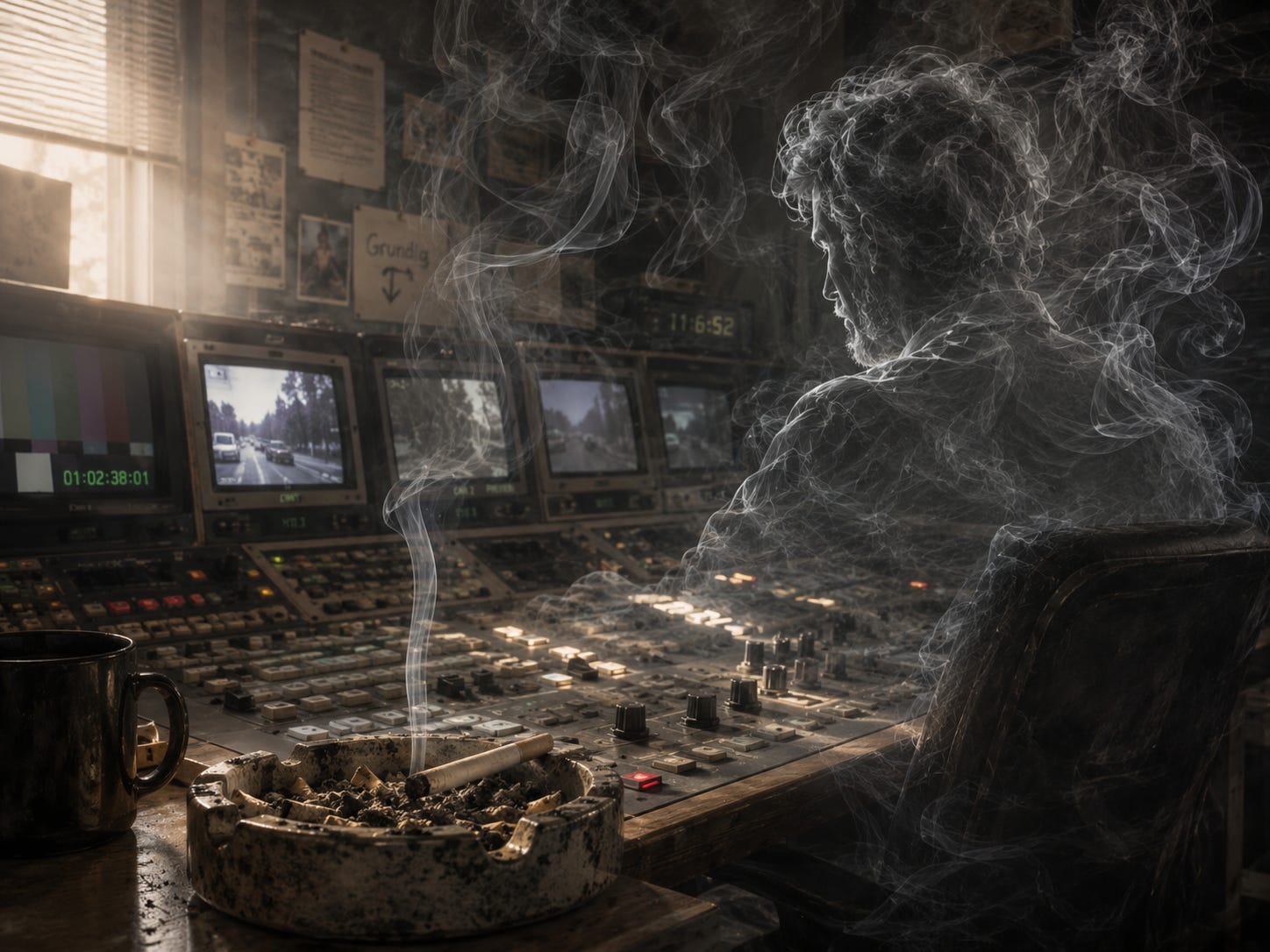
I think I’ve mentioned Johnson before—my favorite cameraman. I’m bringing him up again because I realized something: I met him exactly thirty years ago today. And that feels worth a few paragraphs.
He was a tough bastard, but unbelievably thin. If he turned sideways, he practically disappeared. A ghost wrapped in torn jeans, a plaid shirt, and a beard that looked like it had simply grown there by accident. I saw him eat exactly once in my life. Even then, he was squeezing liver paste straight from a tube into his mouth, chasing it with dry crackers. For the most part, he kept himself alive with coffee and tobacco products. Overall, he had roughly the same relationship with self-care as a wild boar in the middle of nowhere.
He had taken an unusual path to get there. Originally, he was a precision technician. For years, he repaired VCRs at some company whose name nobody remembers anymore. Then technology moved on and quietly wiped out his livelihood. The company got restructured, and to his own greatest surprise, he somehow ended up at a cable TV station with a camera on his shoulder. As far as I know, he never once thought of himself as a cameraman. He called himself a “picture framer”. But you could hand that man the cheapest, most miserable piece of camera equipment ever manufactured, and somehow he’d still come back with footage you could actually use.
“Give me a sheet of paper and a pencil. I’ll make it work.” That was one of his favorite lines.
“Ever feel like working with decent equipment for a change?” I’d ask him sometimes, because I knew he was capable of miracles.
He’d just shrug and mutter, almost bored: “Oh, come on, Radley. For these people? For this money?”
The funny thing was—he wasn’t burned out. He wasn’t bitter. He just didn’t talk much. You could drive with him for half a day without hearing a single word. And that was on days when he was actually interested in the conversation.
I remember our very first shoot together got completely washed out by rain. Some outdoor festival in the countryside. But in that storm, no sane human being was going anywhere near the stage—hell, not even near the venue. So after half an hour of waiting, we killed the story and started driving back to the newsroom.
“Fuck.”
Johnson delivered this observation somewhere around halfway home.
Then we drove in complete silence for another fifteen minutes.
“Fucking rain.”
He spoke again, and I watched him suspiciously, because he suddenly seemed unusually talkative. The next time I heard his voice was when we pulled up in front of the newsroom.
He turned off the engine and said: “Could’ve been a damn good story.”
A few weeks later, one evening, I went upstairs to the studio to clean up a little. Because in a cable TV newsroom—regardless of your job title—you also do janitorial work. Sometimes the reporter cleans. Sometimes the cameraman. Sometimes the editor-in-chief. There’s only one person who never really feels responsible for any of it. The cleaning lady.
I was moving cables around, rearranging furniture, mostly trying to make the place look slightly less like the final vision of a clinically obsessive hoarder. I wasn’t making dramatic progress. Johnson was sitting in the control room, editing a news package. Silent. As usual.
“Johnson,” I said, suddenly craving some form of human interaction. “Which DVD player does this remote belong to?”
He didn’t even look up.
I stood there for a while—probably looking fairly pathetic—then gave up and went home.
The next morning I walked back into the studio. Johnson was sitting in exactly the same spot. Honestly, I could easily believe he’d been there all night. He looked at me and said:
“The Grundig.”
And let me be clear—I’m not complaining. I loved working with him. Sometimes the whole experience felt like Buddhist meditation. Or a sitar concert. You know the kind—three distant-looking Indian musicians plucking unrecognizable string instruments, and after three hours you leave the hall, have dinner, take a shower, get some sleep, come back the next morning… and they’re still on the same song.
One of our last assignments took us through a small town. The good citizens had proudly placed their coat of arms by the roadside. It showed a bear. Holding a sword.
“The city of sword-fighting bears,” I noted, mostly to keep alive a conversation that had never technically begun.
For some reason, Johnson seemed genuinely energized by the subject. Meaning he answered almost immediately. About twenty minutes later.
“Yeah. I was wondering the same thing. What the hell is an animal like that doing on the crest of a half-desert dust hole?”
“Johnson,” I said sternly, with complete seriousness. “Please don’t be prejudiced. You have no idea what the ecosystem looked like here five hundred years ago.”
“Fair point.”
He nodded thoughtfully.
Then twelve minutes later, he added: “Although… even five hundred years ago, a sword-fighting bear probably would’ve attracted some attention.”
In his final active year, both of us received the city’s press award. When I arrived at city hall, I almost walked right past him in the hallway. That’s how elegant he looked. Perfect suit. Perfect tie. Pressed shirt. Polished shoes. We both laughed when it turned out he was just as shocked to see me wearing a Hugo Boss suit from a sponsor instead of my usual jeans, sneakers, and stretched-out T-shirt.
The mayor handed out the awards. Johnson hated that man with legendary consistency, so naturally I had to ask:
“You actually taking it? Or are you turning it down with some lame excuse?”
He looked at me with complete seriousness.
“You should never refuse an award, Radley.” Then he paused. “You should live in a way that makes sure you never get one.”
Even the mayor noticed Johnson’s fashionable appearance. He wanted to make a joke—which, in his case, usually ended in verbal disaster. Holding the certificate, he turned to Johnson and asked:
“Well, Mr. Cameraman… you’re looking particularly elegant tonight. What happened?”
Johnson didn’t even blink.
“Our gas meter rolled over a hundred thousand at home.” Then he nodded toward his suit. “Seemed like the kind of occasion you dress up for.”
He’s… gone now. On his sixty-fifth birthday, he hung up the camera and retired to enjoy his hobbies. Which, as far as anyone could tell… he didn’t have. He disappeared into a property in the middle of nowhere—a place he had built entirely with his own hands, and which—for reasons no rational person could explain—he insisted on calling a “house.”
When the mood struck him, he’d occasionally putter around in the yard for a while, busy with things that didn’t appear to have any practical purpose whatsoever. Mostly, though, he sat in an armchair and watched television.
That’s where his daughter found him. A few months after his final shoot. The TV was still on. Johnson wasn’t.
I have no idea where his soul ended up. But if they’ve got liver paste, coffee, and cigarettes up there—I’m pretty sure he’s doing just fine.