
It Happened to Me Too
An Indie Author on the Edge of a Nervous Breakdown

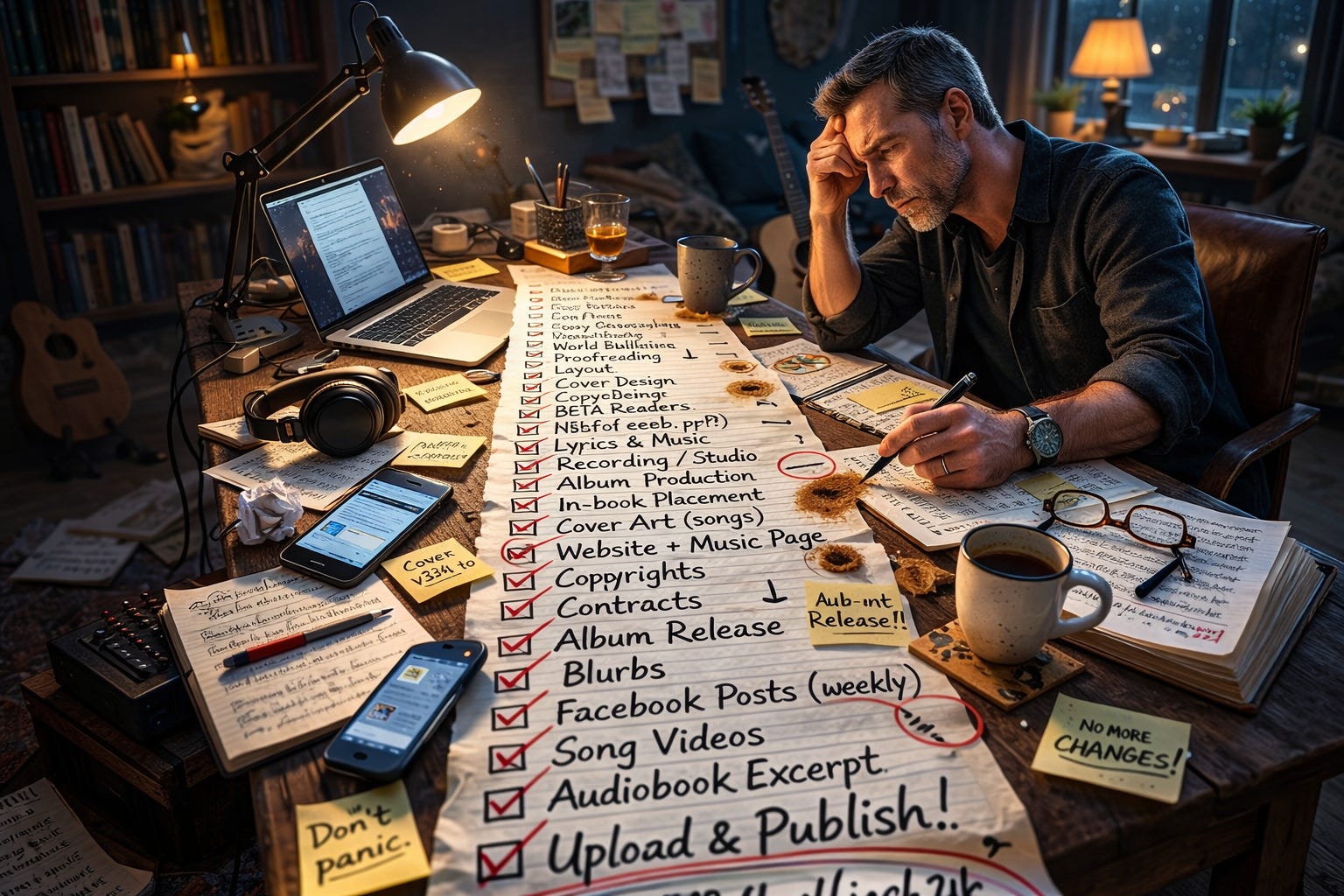
I managed to sabotage myself spectacularly. I’m never doing this again. (There, another promise I can break next time.) Through sheer overplanning, I ended up experiencing every indie author’s worst nightmare. Well, one of the worst. There are several.
Inactivity.
My latest novel, Siobhan’s Pearl, is a medieval Irish folk-fantasy that includes fifteen original songs. So when I started working on it about a year ago, I had the brilliant idea of timing the release to St. Patrick’s Day — one of Ireland’s biggest holidays. March 17. This year it fell on a Tuesday. Perfect. That means release day: Saturday, March 14. Flawless.
Up to that point.
After making the decision, I created a “what needs to be done” list to see exactly what I was committing to. It looked like this:
shaping the story arc
character design
plot-building dialogue
worldbuilding
finalizing chapters
patching dramaturgical holes
proofreading
layout
cover design
copyediting
beta readers
ISBN registration (epub, pdf)
lyrics and music
arranging, recording, studio work
producing the companion album
placing songs inside the book, designing single covers
building an online music player page
designing the website subpage (images, text, uploads)
registering copyrights
publishing contracts
releasing the album
writing blurbs
defining thematic categories
one Facebook post per week
producing and publishing videos for selected songs (That’s What a Girl Gets, Dublin Girl, A Farewell Glass, The Silence Awaits Me)
audiobook excerpt (Arthur and the wise-woman)
uploading and publishing the book on distributor platforms
I finished the list, put it down in front of me, read through it —
—and had such a panic attack I almost booked an appointment with a psychiatrist.
Because this is impossible. Completely insane. A year isn’t enough for this. What idiot ties a release to St. Patrick’s Day? Don’t even start. Cancel the whole thing. Okay, start — but we have to postpone. The Irish probably celebrate something in September. We’ll release it then. There’s no way this is done by March. You’re an idiot, Radley - your mother told you so. And so on.
By January?
I was finished.
With everything.
And there were still more than two full months left before release.
Those two months turned out to be perfect for completely driving my environment crazy. They were also perfect for learning what an editor is actually for.
In the Radley Handbook, the definition now reads: ”Editor — the person an indie author can drive to death with nonsense during a period of inactivity.”
I stayed fully committed to that definition until publication day. To her credit, Kate — my editor — held the line. She may very well have spent her nights weeping into a pillow, cursing the moment she first walked into my office. But during the day she mostly received the fact that I was dancing on the edge of a breakdown without blinking.
I wasn’t easy. I redesigned the cover. Three times. Hunted commas and typos like a man possessed. Swapped video cuts two hours before publication. I was unbearable. I admit it. But I had to keep fiddling with something just to make time move.
The only thing I wasn’t allowed to touch was the songs. The moment a recording was finished and I accidentally said “okay,” Kate immediately filed the copyright paperwork and calmly informed me that if she had to redo it, she would be smashing my head into the nightstand instead of her own.
Evenings were not always quiet between us.
“Hi Kate, do you think—”
“No.”
“Okay, I was just thinking—”
“No.”
“But what if—”
“Dial it down, Radley, or I’m pulling you through this phone. It’s 2 a.m. Drink something sweet and go to sleep before I report you to the union.”
Charming company. Undeniably. But I simply couldn’t understand how this was possible — because everything worked. Look at that list again. It’s intimidating just to read, and you didn’t even have to execute it. (If you’ve lived through something similar, you know exactly what I mean.)
Then one evening something strange happened. I decided that during the final two weeks before release, I would read one chapter every night. No agenda. Just as a reader.
And I found myself nervous all the way through. As if I hadn’t written it.
Whenever I used to hear writers say, “I was only the hand holding the pen; the story wrote itself,” I’d immediately picture a ghostwriter in the background and smile. “Sure, buddy. You just signed the cover.”
So here’s my public apology to every writer I’ve ever privately rolled my eyes at.
Because now—
—it happened to me too.
Don’t misunderstand. While reading, it didn’t feel foreign. My words. My sentences. My story. (My midlife panic, because apparently that’s all you’re allowed to write about at my age.)
And yet the question was there: ”Did I really write this? How?”
I walk a lot with our dog, in the evenings, our shared activity is wandering in the forest. This has been the case for the past year as well. Luna – that’s her name – took care of these dog-related things: sniffing around, turning molehills into flat ground, annoying badgers, and such. I set out with an empty mind. And by the time we returned home, I had a finished set of lyrics, a polished dialogue scene, or an idea that twisted the plot one more turn.
It felt less like I was working on the text — and more like the text was working inside me.
It was a strange experience. And I think the result turned out pretty good.
I love every book I’ve written. Each one carries strong memories of its own season. But this was the most unusual creative process I’ve lived through.
Even if I almost checked myself into a psych ward during the last two months.
Of course, we’ll renegotiate all of this when the next book comes along.