
Interchangeable Fairy Tales
Stories You Would Recognize Even in Your Sleep

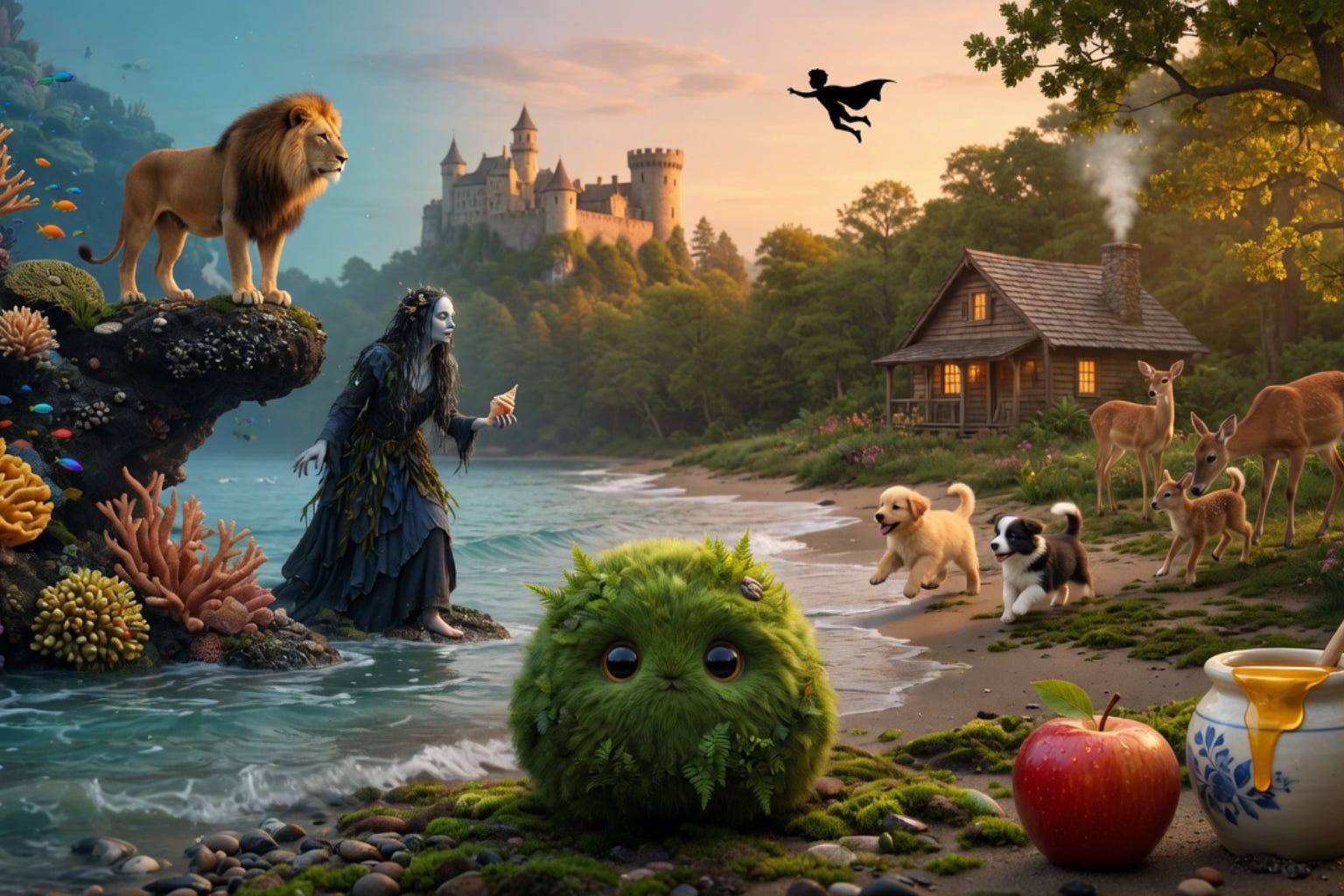
I’m afraid, Kate — my editor — has read far too many fairy tales. She has developed the firm conviction that, at their core, all fairy tales are essentially the same—or at the very least, that the characters within them can be swapped without any real consequence.
It seemed like an interesting theory. Or at least something worth spending a little time on. So—after a series of near-lethal arguments—we gathered a handful of well-known tales and set out to see whether we could build something resembling a coherent story around a single central character.
At this point, however, we ran into a new problem: every possible character had already been used. A rabbit? Done. A dog? Many times over. A duck? Of course. A bear? Countless. A fox? By the dozen.
We were on the verge of giving up when, in the end, we found the perfect character. One who—despite all logic—had never had a fairy tale written about them.
The following story is about that character.
The Adventures of Mossy Mopsy
Once upon a time—not so very long ago, and yet in those days that have long since dissolved into the mist of the past—there lived a piece of moss named Mossy Mopsy, who dwelled in the depths of the sea in peace and unchanging stillness. Long, long years passed in such a way that he had neither worry nor duty; he simply drifted in the water and allowed the waves to gently smooth the affairs of the world around him. He believed this would remain so forever, for how could that which had always been the same ever change? Water would remain water, he thought, and whatever lay beyond it did not matter.
But one day, great trouble came upon him. His father, whose name was Mufasa, was cast down from the edge of a coral reef by his own brother. This brother was not of a kindly nature and believed the time had come to seize power over the seas. And in that moment, for the first time, a realization took shape in Mossy Mopsy’s heart: he had to leave, for what had been could no longer remain.
His journey proved more difficult than he had first imagined. This was especially so because an old acquaintance of his—a rather peculiar monkey-fish—kept trying to lift him above its head, as though this might somehow improve his situation. Mossy Mopsy did not find this particularly helpful, but he did not object. He simply endured it—and then allowed the currents to carry him onward.
As time passed, the sea began to feel smaller to him. He sensed that beyond it—somewhere out in the vast unknown—there was something else, something unfamiliar and inviting. And so he decided to leave the water and make his way onto land, however strange it might seem.
Along the way, he encountered a crab who clung to him stubbornly. When the crab heard of his plan, he immediately burst into song, praising the virtues of life in the sea and warning against the foolishness of abandoning it. Mossy Mopsy listened for a while, then said nothing and moved on.
Not long after, he came upon Ursula, the sea witch. She appeared helpful and told him she would aid him in reaching the shore. But every favor has its price: in return, she asked only that if she ever offered him food, he must accept it. Mossy Mopsy did not consider this a heavy burden, for he could not imagine it ever causing him any trouble. And so he agreed.
Thus he came to the land.
At first, everything was strange and unfamiliar. He found himself in a dense forest, where so many sounds and movements surrounded him that he could not decide what to pay attention to. And so it happened that he failed to notice danger approaching.
Not far from him, hunters were driving a deer toward a clearing. Mossy Mopsy could no longer move aside, and the deer stumbled over him and fell. The shot missed its mark, and the hunters left in frustration.
Not long afterward, a young fawn approached him.
“Hello,” it said politely. “My name is Bambi. Thank you for saving my mother.”
Mossy Mopsy did not fully understand what had happened, but he nodded politely and continued on his way through the forest.
He did not hurry, for he had nowhere to hurry to. Nor was he afraid—not because there was no reason to be, but because he did not know there might be a reason, having never learned the laws of the forest. Still, he started slightly when a barefoot boy wearing only a loincloth leapt out before him from the bushes.
“We are of one blood, you and I,” said the boy.
Mossy Mopsy was about to reply when a surly bear stepped out from the trees and, without a word, carried the child away. Mossy Mopsy judged that this was not his concern and did not intervene.
The forest grew denser, and Mossy Mopsy grew tired. Not long after, he came upon a small cottage. He knocked, but no answer came. Having never seen a door before, he studied it for a time, then discovered how it worked and went inside.
Within, he found seven beds, seven plates, seven toothbrushes, and many other things—seven of everything. There was only one thing of which there was just one: an immeasurable amount of disorder. Though Mossy Mopsy preferred order, he did not concern himself with it just then, for he was hungry. In the pantry, he found a jar of honey, which he ate after chasing away a plump, yellow-furred bear cub who had been guarding it. Afterward, however, he did set a little of the place in order, because it seemed the proper thing to do.
Not long later, singing could be heard outside: seven dwarfs were returning home. After a brief discussion, they allowed Mossy Mopsy to stay, provided he helped with the household tasks. Mossy Mopsy was somewhat concerned by the magnitude of the work, but the dwarfs reassured him that the forest animals would assist. And so they came to an agreement.
For a time, all went well, and Mossy Mopsy thought he might live out his entire life this way. But one day, Ursula appeared. She did not seem friendly, but she brought with her an apple and said that he must eat it. Mossy Mopsy remembered his promise and took a bite.
The apple was so sour that he immediately lost consciousness.
When he awoke, he was lying in a glass coffin. This did not please him, and so he began to pound on it until he was finally let out.
He found himself in a castle, where a prince lived. The prince was not particularly handsome, but otherwise seemed quite normal—except for the peculiar habit of conversing primarily with tea sets. Mossy Mopsy did not understand this, but chose not to comment.
Having by now grown accustomed to tidying up, he set about putting the castle in order as well. However, while working, he pricked his finger on a needle and fell into a deep sleep. In his dream, the prince attempted to force a glass slipper onto his foot, but with little success, and so, out of sheer boredom, Mossy Mopsy turned into a pumpkin at ten o’clock that evening.
Not long after, he was awakened by the sound of barking.
A hundred and one puppies ran across the castle courtyard, and behind them flew a boy dressed in green. Without hesitation, Mossy Mopsy leapt onto the boy’s back.
“Where are you going?” he asked.
“To Neverland,” the boy replied.
Mossy Mopsy was silent for a moment, then said, “I would like to stop by the sea.”
The boy shrugged. “That can be arranged—but we’ll have to hurry. Pirates are after us.”
In the end, they landed on the shore. Mossy Mopsy slid down from the boy’s back onto the sand and stood there for a long time, silently watching the water. The boy said his farewell.
“Good luck, Mossy Mopsy. It’s time to grow up.”
Mossy Mopsy did not answer. He slowly slipped back into the water and allowed the waves to close around him, smoothing everything away.
Just as before— and just as he had always known it to be.
(Well… I’ll be damned. This actually works.)
Thank you. I'm glad you liked it 😀
This is delightful!