
Fifteen Words
A Style Exercise Against Burnout

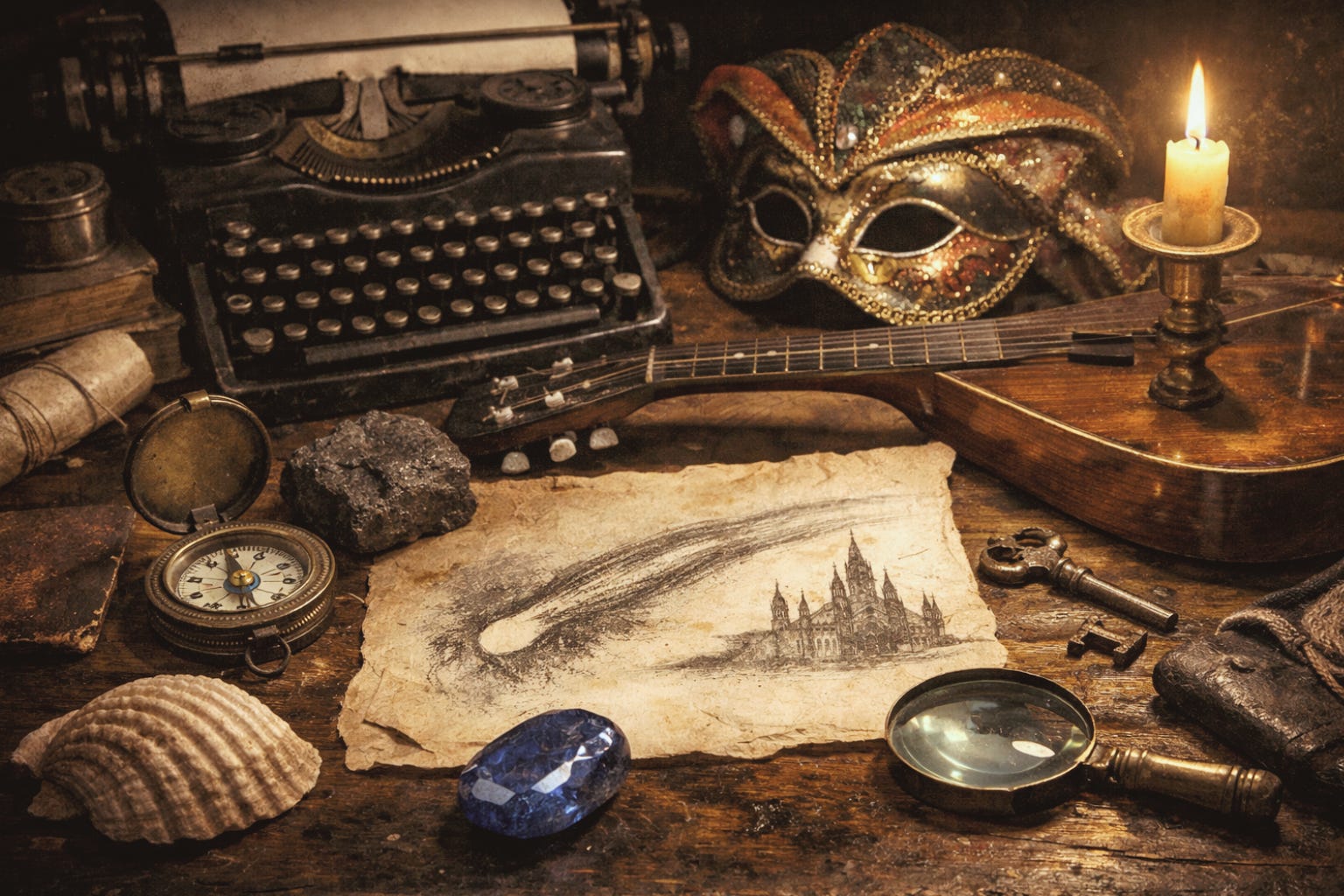
Burnout. Whatever field you work in, you’ve certainly met this feeling at some point. If you’re a doctor, you may be as dedicated as anyone alive, but by the thousandth surgery even washing your hands begins to hurt. If you’re a bus driver, sooner or later the route will start coming out of your ears. If you’re a zoo squirrel, one day you’ll inevitably get tired of running in the same wheel all day long.
And if you’re a writer… If you’re a writer, you experience it after every book you send out into the world. “Can I still write?” “Will I have another idea?” “Do I have anything left to say?” Things like that.
Since I started writing on Substack, I go through this little burnout every week, which means I probably didn’t do myself any favors. Of course I won’t stop, because another idea always shows up sooner or later — but I did play with the thought: what if one day nothing comes at all?
So I came up with the following experiment.
I asked my editor to give me fifteen words — preferably completely unrelated ones, from any corner of life. My task was to write a short story using those words, exactly in the order I received them. All I could do was hope the result wouldn’t turn into surreal nonsense.
Kate delivered the list without hesitation. Here’s what she gave me:
- compass
- basalt
- comet
- mandolin
- parchment
- canopy
- irony
- storm
- cathedral
- desert
- sapphire
- carnival
- shell
- workshop
- vortex
To be honest, she made it quite a challenge. I was curious myself to see what would come out of it.
This is the result.
An Old Map
The rain was pouring down — Robert Marlowe could barely tell where he was. The city looked as if someone had tried to wash away its sins — with very little success. The worn-out windshield wipers fought hopelessly against the curtain of water while Robert tried to wipe the fog from the inside of the windshield with equally hopeless determination.
“Wouldn’t hurt to have a compass,” he muttered angrily.
Not that a compass would have helped much. The mere sound of the GPS calmly announcing “continue northeast” was already enough to give him a stroke. Besides, he was hungover — which wasn’t exactly rare for him — and combined with the downpour it made getting started particularly unpleasant. Something he didn’t particularly feel like doing anyway. But there was no way out of it. He owed a lot to the man for whom he had skipped his usual medicinal beer tonight.
He almost missed the bus stop in the rain. He slammed the brakes, backed up, then leaned across the passenger seat and opened the door from the inside — because with his old, battered Ford Sierra that was the only reliable method. From the outside it would have required a crowbar.
“Hop in, Basalt.”
The large, soaking wet man who collapsed into the seat was actually named George — and he mostly made his living harassing people who had fallen behind on loan payments, occasionally using his fists to make a point. He had earned the nickname because he was cold, square, and hard.
He slammed the door with frightening force, shook the water off his coat, and stared at Marlowe.
“What’s wrong with you?” he asked. “You look like a comet just landed on your head.”
Robert felt a dull stab at the back of his neck — the same sensation he always got whenever Basalt said something like that. They had been classmates at university. Basalt had graduated in astronomy before becoming a professional enforcer, which meant that every second sentence he spoke contained some reference to a celestial phenomenon. Robert knew this — but that didn’t make it any easier to endure.
“I’ve been drinking,” he muttered.
“So… the usual?” Basalt grinned and leaned back in the seat.
“Let’s go.”
They barely spoke after that. The big enforcer mostly gave directions with hand signals. They cut through bright, busy streets and soon ended up in a back alley on the outskirts of the city, among burning oil drums and extremely questionable forms of life.
They jumped out of the wreck of the car and ran toward an equally wrecked building, trying unsuccessfully to escape the downpour. The place turned out to be some kind of bar. Through the open window came the sound of a mandolin, and Robert Marlowe felt as if tiny horseshoe nails were being hammered into his brain.
“What the hell are we doing here?” he asked, fighting a wave of nausea that was helped along by both the hangover and the smells drifting through the street.
Basalt gave him a meaningful look.
“We’ve got the parchment.”
Marlowe nearly kicked him.
“You dragged me here in the middle of the night, in pouring rain, for a piece of moldy leather? Be careful, because if that’s true I’ll beat you to death with my bare hands and throw your body into the sewer.”
Basalt grinned with such magnificent illegality that a nervous judge would have sentenced him to ten years of hard labor without hesitation.
“I know you’re interested.”
That was a gross exaggeration. Robert knew the man had believed since childhood in the legend that the founders of the city had hidden a secret treasure somewhere here. In a moment of weakness he had once promised that if Basalt ever found a real clue, he would help with the search — convinced that day would never come.
Basalt’s condition had worsened about five years ago. That was when he first heard about the secret map drawn on the parchment, and ever since he had dedicated every free moment to it — when he wasn’t busy intimidating debtors for his employers. And judging by his excitement tonight, he believed he had finally found something real.
He turned toward the door of the bar and knocked.
A hoarse voice answered from inside.
“Password?”
“Canopy.”
Marlowe groaned.
“Canopy?! Who comes up with a password like that?”
“What’s wrong with it?” Basalt grinned. “That’s the name of the owner’s dog.”
He shoved Robert through the creaking door. Inside, the owner of the hoarse voice was waiting for them and silently led the soaked pair into a dusty office.
“I’m Joseph,” he said, turning to Marlowe. “Joseph Secret.”
Robert couldn’t suppress a crooked grin.
“There’s something rather ironic about a man named Secret guarding a secret parchment. I’m Robert. Robert Marlowe.”
The hoarse man burst out laughing.
“Marlowe? And with that name you became a private detective? Now that is real irony.”
At that exact moment the storm hit the city. The rain suddenly seemed like a gift compared to the lightning crashing outside, while the wind shook the windows as if it wouldn’t rest until it managed to tear at least one away.
Basalt sat on the edge of the desk.
“If you two have finished entertaining yourselves, maybe we could get to something useful before the Milky Way falls on our heads.”
Marlowe felt the stabbing pain in his neck again.
”All right. Let’s see the miracle.”
Joseph opened a drawer and casually tossed a large parchment onto the table, covered in chaotic lines.
“Well?” Basalt asked proudly.
“Well? What do you mean ‘well’? What the hell is this?”
“Use that alcohol-soaked brain of yours, Marlowe. You’re an architect, remember?”
Robert gathered himself and studied the parchment carefully. For a while he saw nothing.
Then suddenly the tangled lines began to make sense.
“But this is…” he said, stunned.
“Right?” Basalt’s face lit up.
“This is the ground plan of the old cathedral… But that church was demolished three hundred years ago. Nobody even knows where it stood.”
“I found it.”
Marlowe felt his mouth turn dry as the desert. For five years he had listened to Basalt’s stories about the White Sapphire Cathedral — and now it seemed the man had actually discovered something.
“I see you’re getting interested,” the enforcer winked.
“So? What do you say? Shall the carnival begin?”
Robert closed up like a shell.
“No,” he said firmly, suddenly sober. “Nothing good would come from going treasure hunting with you in the middle of the night.”
Basalt studied him for a moment.
“All right,” he said slowly. “Just one question. Remember that old key I showed you two weeks ago in the workshop? I found the door it opens.”
The key… Robert remembered that key very well. And he felt himself being pulled into the vortex.
Well, I suppose the task is complete. And as a matter of fact, the story itself has started to interest me.
If I’m not careful, it might even turn into a book.