
Fieldwork
Always Carry Cake

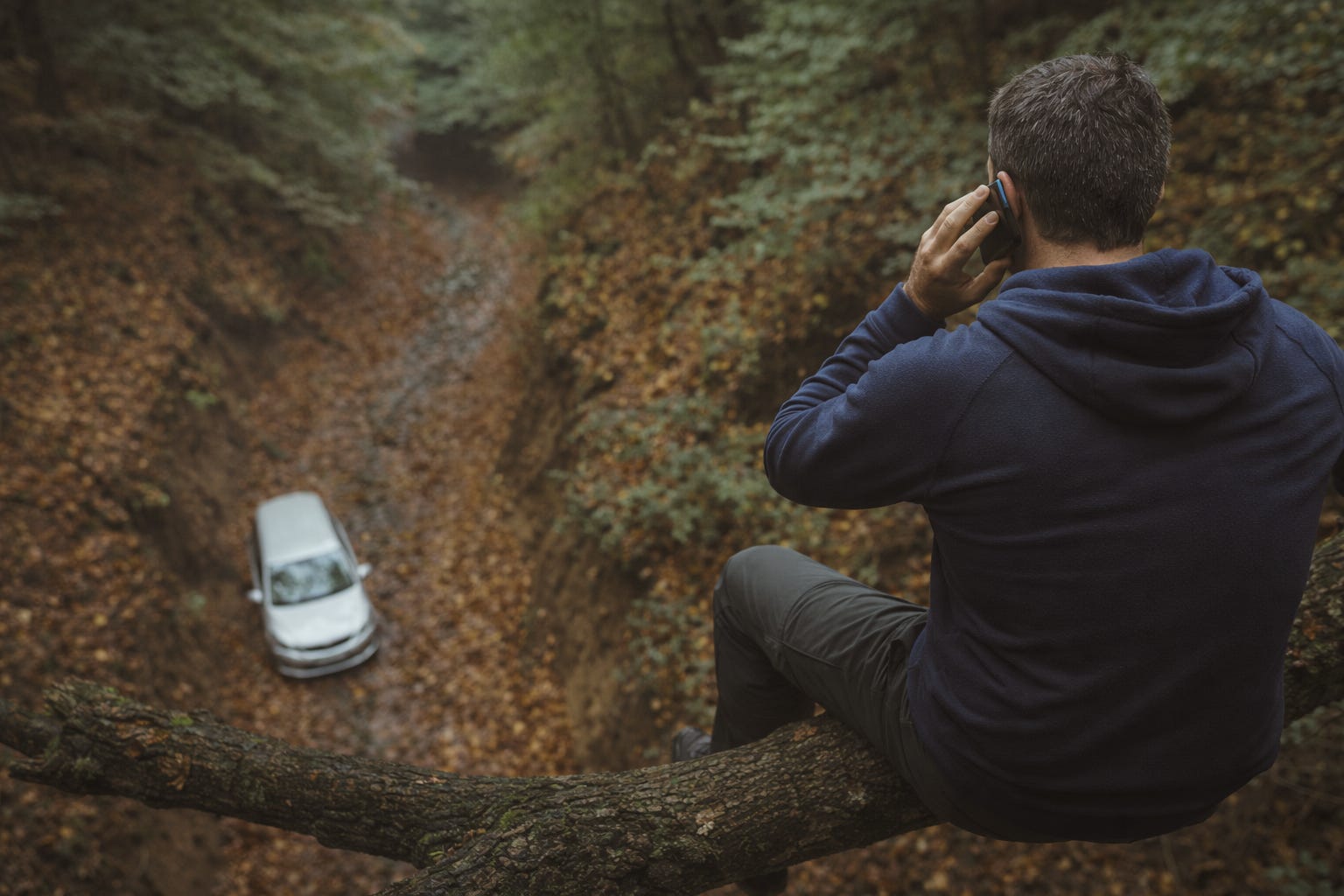
Let me tell you about the time I got stuck in a ravine with a brand-new car that had been blessed by a priest the day before. Yes, I know how that sounds. But things like this tend to happen to me.
For the sake of completeness, we need to go back in time a little. A few years ago there was a summer when Martha and I managed to take an entire week off. That’s not very common in our profession — especially in summer — so we grabbed the opportunity.
The plan was simple. Find a resort near water. Thirty minutes after arrival, collapse on the hotel beach. Get completely roasted by the sun. In the evening, cover our tortured bodies with anti-inflammatory cream. Repeat this exercise five more times. Then go home. I admit it wasn’t a particularly varied program. But at that moment it was exactly what we needed.
Or rather — what we would have needed.
Because on the very day we arrived, the average temperature suddenly dropped by twenty degrees. And stayed there. I’m not saying it was cold — but I did see a penguin buying a plane ticket to Africa. So we had to find something else to do.
That evening I spent hours digging through Google Maps, searching for attractions nearby. And eventually — to my great surprise — I found something about twenty kilometers away from us.
A stupa.
A stupa is a Buddhist religious structure — basically a tower without an entrance, which supposedly contains sacred texts and sometimes a relic of Buddha himself. (Though one should treat that claim with some skepticism. Because if every stupa actually contained a bone relic of Buddha, with a bit of manual skill we could assemble an entire army of Buddhas by now.)
At first I assumed someone had hacked Google Maps and decided it would be funny to place a Buddhist monument in the middle of my country. Because what exactly a Buddhist stupa would be doing in Central Europe was beyond me. To be honest, it still is.
I didn’t even tell Martha where we were going. The next morning I simply put her in the car and started driving. We parked on the edge of a dusty little village and followed a barely visible hiking trail that climbed steeply up the mountainside.
My wife — who is a persistent human being but not fundamentally designed for mountaineering — calmly noted after an hour and a half:
“If this turns out to be some ruined castle, I’m kicking you off the mountain.”
Martha is exactly the same height as Jet Li. And roughly as explosive. Since I wasn’t entirely sure the place actually existed, I tried not to provoke her. So I kept quiet and flattened myself like a garden gnome hiding behind a rose bush.
Another ninety minutes later we stumbled out of the forest. And there it was. The stupa. An incredible sight — standing on a mountain top, in the middle of a forest, next to a village in the middle of nowhere.
But the truly unbelievable part came next. Fifty meters from the building we discovered a large parking lot full of cars, connected to the village by a perfectly paved road. We had parked one intersection earlier.
Martha looked at me the way a polar bear looks at a particularly promising seal. The only reason I survived was that the stupa impressed her as well. It was an extraordinary place. Beautiful. Quiet. And somehow full of energy. It was simply good to be there.
Until we got hungry. Three hours of hiking will do that to you.
We eventually found a small gift shop. They didn’t sell food, but the owner smiled kindly and handed us a bag of cheese crackers.
“We’re prepared for idiots wandering around the forest,” he said.
The icing on the cake came on the way back to the car. We met a Nepali monk in orange robes walking toward the stupa. He looked at us, said “hello,” and kept going.
A few months later I told this story to my mother. For reasons I still don’t fully understand she became extremely excited and announced she would like to see this place as well. So we picked a date.
The day before the trip we happened to buy a new car. Our first stop afterward was to visit a priest friend of ours. The two events were completely unrelated — but when the priest heard we had just come from a car dealership to the house of God, he grabbed a container of holy water and ran outside.
“Well, I might as well bless it.”
He blessed the car. Then he asked for the keys and took it for a test drive.
The next morning we set off. We only had to stop once — at a bakery. Martha disappeared inside and returned with a box of cakes and a crate of mineral water. When I looked at her questioningly she simply said:
“Anything can happen. Anywhere.”
After ten years together I had learned to respect her instincts. So I started the engine.
We picked up my mother and Danny Dad — my mother’s second husband, who never actually raised me but somehow still ended up with that title. After a few hours of pleasant driving we reached the village near the stupa. But on that particular day destiny had other plans.
The road was closed. Two policemen explained that a serious motorcycle accident had happened just outside the village. Their suggestion was simple: if we drove back two kilometers we could bypass the accident on a forest road.
The GPS confirmed this was theoretically possible. So we tried. It quickly became obvious that this was a mistake. The road narrowed. The ravine walls started scraping our mirrors. The wet autumn leaves turned the ground into ice.
But what finally stopped us were the potholes. They grew bigger and bigger. Eventually I had to say the words every driver fears: “Well, ladies and gentlemen… this is the end of the line.”
We were stuck. I managed to turn the car around on a sloping hillside, but the wheels simply spun on the slippery ground.
So I checked the map. There was a village about two kilometers away on the other side of the ravine. Under Martha’s supervision I sent my mother and Danny Dad walking. There was no point in them suffering with me while I arranged a tow truck.
“Come on, Danny,” my mother said calmly. “This will be a fucking great little hike.”
She was about seventy at the time - but just hadn’t quite made it home from Woodstock yet.
They disappeared into the forest laughing so hard the trees echoed.
I wasn’t particularly worried. I had cake. And enough mineral water to bathe in. I called a tow company in the nearest town and carefully explained that they must approach from the southern side, because the northern ravine was completely impassable.
Naturally, a few minutes later my phone rang. It was Martha.
“We’re walking along the highway,” she said. “No village in sight. I think those two kilometers are more like ten.”
“That’s not great news.”
“It gets worse,” she said. “I just met the tow truck.”
That was even less great.
“He’s an idiot,” I said. “I explained everything.”
“I told him too. He looked at me like I should go cook something.”
“And you didn’t kick him?”
“I was about to. But he drove off.”
“I’ll pass along your regards.”
Ten minutes passed. Nothing.
Twenty minutes. Nothing.
Half an hour later I was peacefully sitting in the open trunk of the car with my cakes when someone appeared in the ravine. On foot.
“Please,” I told him nervously, “don’t tell me you’re the tow truck driver.”
“I am,” he said sadly.
My anxiety increased.
“And where exactly is the machine that’s supposed to rescue me?”
“A bit further up,” he said. “It’s lying on its side in the ravine. I drove into a hole. Just thought I’d let you know I’ll be busy for a while.”
Then he turned around and disappeared. So it was time for a new plan. Unfortunately, by that time the phone signal had disappeared — apparently deciding that this adventure was none of its business.
Eventually I climbed a tree to find a signal and called the local mayor. Let that image settle for a moment: a highly qualified intellectual hanging from a tree above his own stranded car in a forest ravine, trying to make a phone call in the gathering darkness. Magnificent.
The mayor listened politely, then informed me that every available tractor was currently busy harvesting wheat. I had several inappropriate suggestions regarding what the municipality could do with its wheat harvest, but I kept them to myself. Instead I pointed out that I had not seen a sign at the entrance of the ravine saying: “Do not enter, you idiot.” The mayor immediately became more cooperative.
An hour later the forest silence was broken by the sound of a tractor. Though the noise was bigger than the machine. It looked less like a tractor and more like a robotic vacuum cleaner.
“I didn’t order a cleaning service,” I told the driver.
He grinned.
“I’ve rescued bigger idiots than you from here.”
Ten minutes later we were back on asphalt. I paid him, thanked him, and drove off to collect the family, convinced I would find them half-dead beside the road.
Instead they were sitting in a restaurant. Still laughing. My mother was entertaining Martha with embarrassing childhood stories about me while Danny Dad was making friends with a large beer.
We ate. Then we drove home. I was exhausted and couldn’t wait to get into bed.
But life rarely works like that.
We weren’t even halfway home when my phone rang. It was Johnson — my cameraman. One of the few people whose call I answer even if crocodiles are chasing me.
“Radley,” he said quietly. “Could you help me?”
“Of course. What happened?”
“I took a whole box of sleeping pills.” He paused. “And I think that might have been a mistake.”