
Central Italian, Advanced Level
Fragments from a Trip

I’m sitting in front of the computer, the page still blank, and my head not much better. Which is strange, because I should have plenty to write about after my trip to Central Italy—but for some reason, all I have are fragments. Not because I was drunk, or anything like that. It’s more that the whole experience was so intense that it still hasn’t assembled itself into one coherent picture.
Fine. That’s where the fun begins.
I went by car, not by plane—because I believe that if God had wanted humans to fly, He would have given us wings. The other reason is that this way I feel more like my own master. Meaning that instead of wasting two or three hours sitting around in an airport lounge, I can spend my time more usefully.
For instance, by wasting two or three hours sitting at an Italian highway tollgate.
Speaking of tollgates. In Italy, you recognize them by the fact that a two-lane road suddenly turns into fifteen lanes, and the nervous breakdown begins. Based on the ancient principle that “the other lane is always faster,” several drivers decide, about thirteen feet before the barrier, that they absolutely must cut across at least nine of the fifteen lanes, which leads to crowded little scenes and verbal exchanges in which physical violence is frequently placed on the table as a future possibility.
I should add: if you are the one doing this, and you do it right in front of me, I too will place physical violence on the table as a future possibility.
Actually, if for some reason NASA made me Director of Operations for a week, I would immediately launch seventy percent of the people responsible for the Italian toll-payment system into outer space. And even among the remaining thirty percent, there would be a few who survived only on humanitarian grounds.
Speaking of outer space: viewed from that direction, Italy is famously shaped like a boot, with its upper part clinging to the rest of Europe in the north. Which means that if you approach it by car from that direction, you enter through the mountains—and you quickly realize that mankind has not defeated nature. There are partial victories, of course, as demonstrated by the tunnels several miles long, but even those are nothing compared to nature’s performance.
Interestingly, I also drove through a tunnel that had no mountain above it. At first I thought it was a practice tunnel, designed to prepare you for the real ones. Then I realized it was probably just Italian foresight: if a mountain ever appears there, at least they won’t have to mess around with building the tunnel.
Highways are recommended not only because of the tunnels. They are also recommended because if you get lost on the mountain roads, whether you ever see the sun rise again over a populated area depends entirely on luck. And if you get stuck behind a truck trying to save money by avoiding toll roads, you are not getting free anytime soon, because overtaking on those winding roads is impossible.
And winding roads are guaranteed, because Italians don’t waste much time worrying about elevation changes. They have already accepted, at least, that most road vehicles are not especially well suited for vertical movement. But they are not willing to make too many concessions in this area. A two-thousand-foot elevation change? They handle it with three turns. Individually, of course, each turn is three miles long.
From a traffic perspective, the vast majority of Italian cities most closely resemble an open-air visitors’ day at a psychiatric institution. The streets are flooded with cyclists and motorcyclists apparently preparing for collective suicide. On top of that, every street is one-way, and that direction is usually the exact opposite of yours.
The ring roads around the city centers have roughly a thousand lanes, decorated with road markings that ignore the basic laws of logic. There is no point trying to read the signs, because they contain enough text to embarrass a multigenerational family saga. And if you spend too long reading them, you’ll probably crash into one.
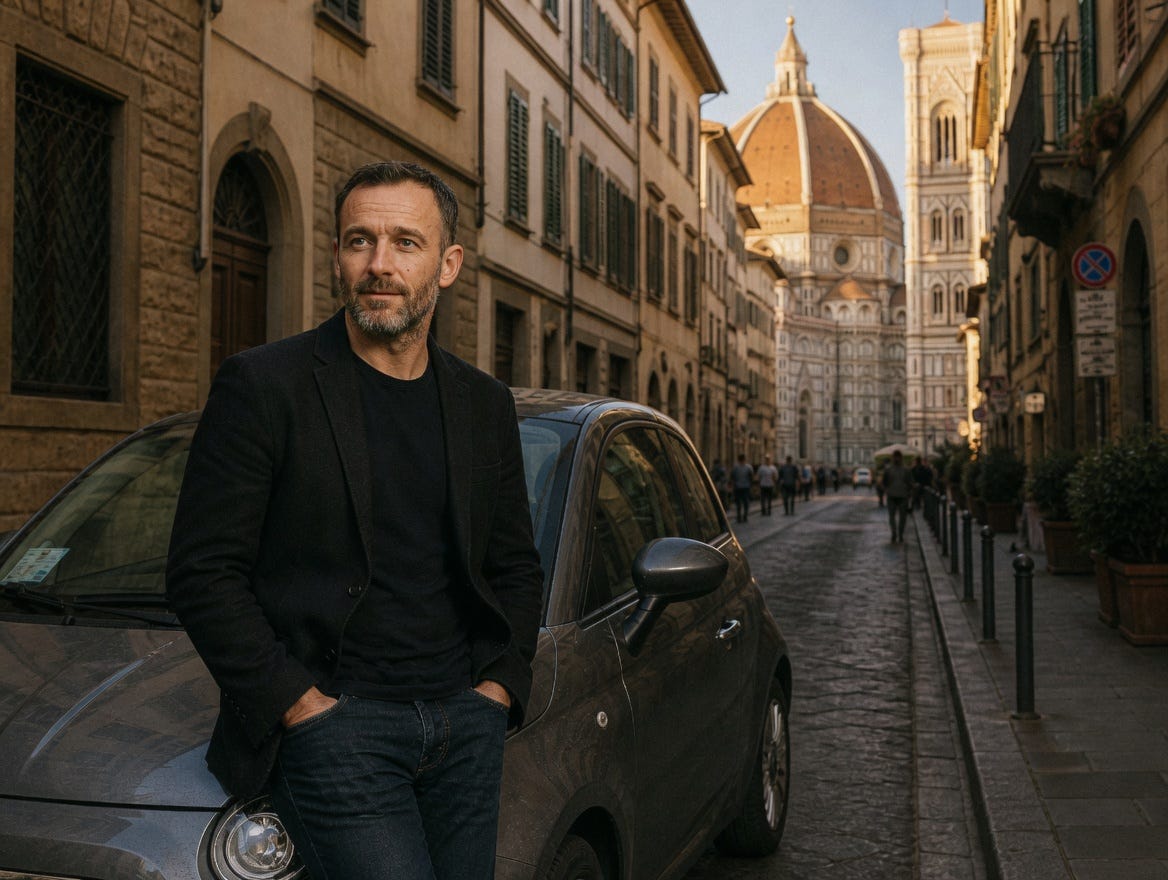
Personally, I worked by instinct. As a result, in Florence, I managed to drive almost all the way to the foot of the Duomo, which is about as illegal as posing naked with Michelangelo’s David. I did not try the latter, for the record.
Although nothing above clearly suggests this, I did eventually reach the apartment where I was supposed to stay. Though given its condition, perhaps it would have been better if I had disappeared forever somewhere in the mountains.
Well. I have been to a few leper colonies in my life, but this apartment would definitely have placed in the top two. Of course, I know I had signed a document stating that, in order to preserve the natural environment of Mediterranean accommodations, the appearance of a rat, a crocodile, or a snake-catching mongoose would be considered normal. But this place was also dirty—which suggests that the phrase “final cleaning paid in advance” meant the cleaning lady was on her deathbed when she mopped the floor.
I know that, apart from ancient ruins, the one thing everyone cares about when it comes to Italy is the beaches. So: they are good. Sandy shore, salt water, avoid being on the beach between noon and three, and there is a screaming soft-drink vendor with a tracked handcart. Yes, tracked. Like some kind of amphibious assault vehicle, but with Fanta.
And if you notice a human-trafficker-looking Italian suddenly kneeling in front of your child and taking a picture, you do not necessarily have to knock him out by reflex. He is, in fact, a photographer. He will give you a card with the address of his studio on it. If you want, you can go there in the evening and buy the developed photo. If you don’t want to, then you don’t.
And now, the ancient ruins. There are plenty of them in the coastal towns of Central Italy. In fact, this is also where you’ll find the legendary Rubicon River, which Julius Caesar famously crossed on one occasion. However… in that part of the world, it sometimes feels as though they treat certain historical remains rather ungratefully. I found, for instance, a very old bridge that its thankless Italian descendants had simply paved over, apparently under the guiding principle of: “Yes, I understand it’s ancient, but people still have to get to the store somehow.”
So the main attraction of these towns is, in practice, the pedestrian street. This is usually the second street back from the sea, and it can best be described as a tangled cluster of restaurants, grocery stores, bars, and completely useless souvenir crap. In the evening, you have no chance of parking anywhere near it, so either you walk in from the other side of the railroad tracks—which are always nearby—or you park on the other side of the railroad tracks and walk in.
A significant portion of Italians, including restaurant staff, are not particularly hospitable. They accept that tourists exist, and they will take your money in every possible way without the slightest difficulty, but they tend to view you less as a welcome guest and more as a necessary evil.
If they do grow fond of you—meaning you ordered enough—then at the end of the meal you receive a gift from the house, usually in the form of some kind of pastry. One more useful thing to remember: if a restaurant is nearly empty, that is usually not an accident.
That said, I have no complaints about Italian waiters when it comes to their sense of humor. At least not about the waiter I had one evening.
One of my core principles is that I do not eat anything whose name I would be unable to pronounce in an ambulance. Unfortunately, I do not speak a word of Italian, so when faced with an Italian menu, I had to improvise. I pointed to one of the words and, with the confidence of a seasoned gourmet, announced that I would like two portions of Erinelli Cieconelli.
The waiter informed me, without blinking, that he could only bring one—because Erinelli Cieconelli was the restaurant’s chef.
If you don’t mind, I’ll continue with these small, practical tips instead of listing all the museums, churches, and public buildings in the area, because Rimini, Riccione, Ravenna, Florence, and San Marino are real experiences only when you are there and see them for yourself.
Actually, I have to retract part of that previous sentence immediately, because San Marino does deserve a few thoughts.
It is an interesting place: an independent republic right in the middle of Italy. They speak Italian, use the euro, and live in a customs union with Italy. In other words, it looks like a cat, acts like a cat, but somehow it is not a cat—it is an independent republic, one even Napoleon left alone back in the day.
San Marino’s founding is connected to a Dalmatian stonemason suffering from an acute case of Christian persecution. He was the one who retreated into the mountains to become a hermit. The locals supported him until the relatives arrived and carved out of the rocks one of the great achievements of man-made human environment. Those Dalmatian stonemasons clearly knew a thing or two—if they have any living descendants, maybe they could take a look at Mount Rushmore.
Among San Marino’s tangible attractions are the republic’s stamps, which collectors like; the liqueurs, which ladies like; and the chocolates, which I like. I bought a half-kilo bar somewhere. I had never bitten into a piece of chocolate that large in my life.
But back to the little tricks.
One of them is that you can find guidebooks about every attraction in every city from street vendors. Translated into every language in the world, too. There may not be an Udmurt edition, but so far no one seems to have filed a complaint.
And here is the trick: in parking garages, you can usually find free city maps with descriptions of the sights. Which means they contain basically the same information as the guidebook.
On the street, by the way, you can buy not only guidebooks but practically anything. When I was in Ravenna, for example, the hit product of the year was a genuine Dolce & Gabbana handbag for ten euros. I know it was genuine because one of the vendors swore on his mother’s life.
Another idea: definitely eat gelato, unless you are allergic to it. Italian gelato is world-class. However: the portions are brutal. If you want to try several flavors, divide the job among family members—everyone orders something different, then you swap as you go. If you are traveling alone, spread the task out over several days, or organize a group tasting with total strangers. (No. Actually, don’t do that.) I’m only saying this because if you accidentally order the same size portion as the Italians, you could keep a polar bear at operating temperature for a year and a half.
A piece of advice for city transportation: if you get tired, you may discover bicycles placed for tourists in front of certain historic buildings. There are two rules.
First, if you take the free bike, you have to return it to the same place.
Second, only take the yellow bikes, because those are for tourists, and Italians are rather sensitive when it comes to questions of private property.
There are some very strange rules as well. In certain churches, for instance, you are allowed to take photos—but you may not use a tripod. Or you may take photos—but you may not use flash. Which is practically the same as banning photography altogether, since these places are usually as dark as a jungle at midnight.
And my favorite: in Venice, you are not allowed to photograph the carnival masks being sold on the street. Don’t ask me why. I have no idea. Maybe there is some local legend that if the masks are photographed, Venice will be swallowed by the sea. Or something.
And since I already broke my “no sights” rule for San Marino, I might as well do the same for Venice.
Because if Rome is the Eternal City, then I hope Venice came in a very close second.
Venice is basically an island. Resourceful Italians solved this problem with an unbelievably long bridge. Visiting the city becomes truly enjoyable from the second time onward. By then you have already photographed everything you were supposed to photograph, and you can calmly enjoy the atmosphere.
The best move is to leave your car in the parking garage at the edge of the city, right after the bridge, and then walk to St. Mark’s Square, which is at the other end of Venice. (There are hardly any pigeons there anymore, by the way, although a few years ago those sweet little creatures used to come for your life in a way that would have put Hitchcock to shame.) By the time you get there, you will be dead tired. Which is perfect, because then you can board the water bus called the vaporetto, which takes you back to your car.
There are two kinds of water bus. One makes the trip in twenty minutes. The other takes an hour, because it stops at every crooked piling along the way, and after the final stop I suspect it goes straight to the scrapyard. If it makes it that far.
I should probably stop this article somewhere, so I’ll end with just one small note about what I did every single day in the tourist-attracting feature found all over the area, commonly known as “the sea.”
I swam.
Tökéletesen leírta a saját személyes élményeimet, amiért még nagyon szeretem az olasz életérzést, a gyerekekhez való viszonyulásuk. Az éhező bambinának már kihozták az ajtóban megrendelt pizzát, mikor a felnőttek még csak az étlapot kapták. :D
Hilarious. The most entertaining thing I rad this morning.