
Beyond the Red Light
No second takes. No safe exits.

There has been exactly one time in my life when I burst out laughing during a live television broadcast. I figured I’d tell the story. And since I know people tend to enjoy this kind of thing, I might as well share a few more. Not necessarily educational.
The Viagra Doctor
This happened back when the world had just been introduced to a little thing called Viagra. Originally developed as a heart medication… and then, well — let’s just say it found a more popular application.
We thought it would be a good idea to invite a professor of urology into the studio and have a conversation about it. Tastefully, of course.
Taste wasn’t the problem. The doctor was.
The show hadn’t even started yet, and the man was already so nervous I was convinced he might actually need heart medication himself. So, in an attempt to calm him down, I told him the first three questions in advance.
I never do that. And as it turns out — I shouldn’t have done it this time either.
Because right after the opening “Good evening,” the man answered all three questions in about twenty seconds. Before I had even said a word.
And we still had the entire show ahead of us.
Somehow I clawed my way out of that hole, although by the end I had completely let go of the wheel and switched to a “whatever happens, happens” approach. Fortunately, the doctor loosened up a bit as we went along, so we more or less survived the allotted time.
Still, we had exchanges like this:
Doctor: ”Obviously, it’s not like someone takes Viagra, sits down in front of the television, and just waits for it to work.”
Radley: ”Depends on what’s on TV…”
Eventually, the moment of salvation arrived. I thanked him for coming, he said “my pleasure,” stood up — and walked out of the studio.
Well… Back then, we weren’t using wireless microphones. We had the kind with cables plugged into wall sockets. Which meant that when the man made his exit, he not only walked straight through my camera shot — he also pulled half the studio down with him by the cable.
Live.
I went after him and asked, as gently as I could, what exactly his master plan had been with that exit. He told me he had seen it done like that on major TV networks.
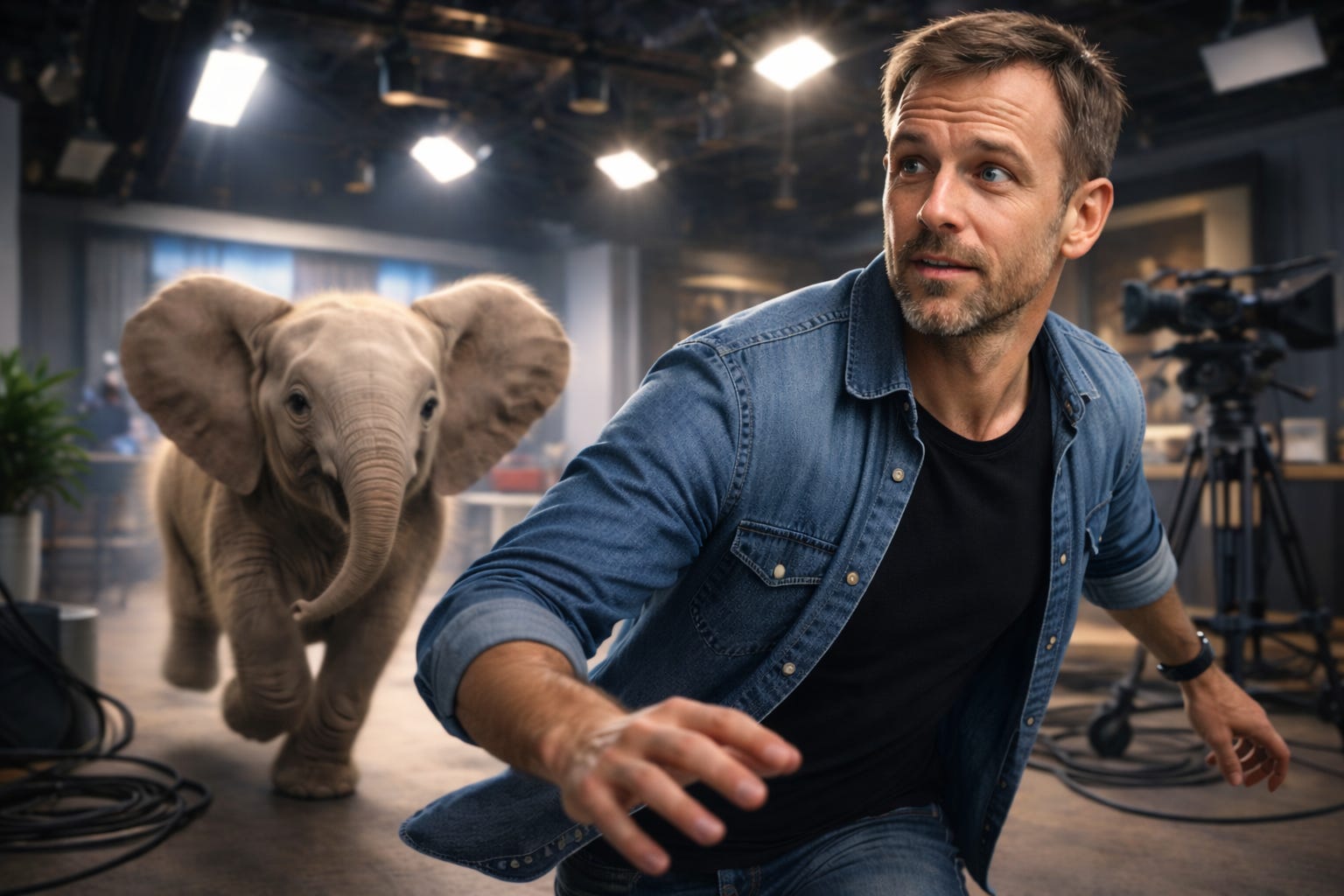
At that point, I ran out of arguments. All I could say was that I had also seen things on major TV networks — including a host being chased by a baby elephant — but I would strongly prefer not to make that part of our workplace policy.
When I Didn’t Laugh…
The former mayor of our beloved city was widely known for the fact that no asteroid would ever be named after him for his intellect.
He had made a number of… memorable statements during his time in office. One of them came when the city was overrun with mosquitoes, and the press started asking why the spraying hadn’t begun yet.
The man gave the following answer:
”Look. If we spray, we kill the mosquitoes. If we kill the mosquitoes, the frogs starve. If the frogs starve, the storks starve too. And if the storks starve… who’s going to bring the babies?”
Funny line. Also deeply cynical. It caused quite a bit of backlash.
So, in an effort to take the edge off the situation, we invited the head of the city’s technical department to the studio and asked her to explain the real reason behind the delay.
She was extremely helpful. And very competent. Public speaking, however, was not part of her job description. And it showed.
Every single word had to be dragged out of her — which, in a thirty-minute live broadcast, is a special kind of torture for the host. Which, unfortunately, was me.
In situations like this, your only chance of survival is to find a topic the guest actually enjoys talking about. Because then — sometimes — they become capable of producing something resembling a coherent sentence.
So I tried:
”A lot of people in the city don’t understand why the chemical mosquito control hasn’t started yet. As far as I know, there’s a professional explanation for that.”
Bullseye.
The woman lit up like a Christmas tree. She clearly loved this topic. Unfortunately, what followed was… less helpful than expected. This is what went out live on air, less than half a day after the mayor’s statement:
”Well, uh, yes, there is… an explanation. Yes. We begin chemical, uh… control when the number of bites per person reaches a certain threshold.”
(For context: a show like this is usually filmed with three cameras. One on the host, one on the guest, and one covering both. In lower-budget productions, only the guest camera has an operator behind it. That was the case here. And the cameraman behind the guest had already been observing the situation with increasing amusement.)
And then came this:
”If I may ask — how do you determine when that threshold is reached?”
”That’s quite, uh… interesting. We employ a bite-counting colleague for this purpose. Yes.”
(The cameraman made a small, painful noise. Still holding it together.)
”And then, uh, when the weather allows it, he goes out into a field where there are many mosquitoes, and then, uh… he stands there shirtless, and the mosquitoes bite him. Yes.”
(The cameraman was now visibly fighting for his life.)
— And then, uh, when the time has passed, we count the bites on him, and if there are enough, uh… bites, then we begin spraying. And the colleague receives twenty cents per bite as compensation.
At this point, the cameraman gave up. He walked out of the set in calm, deliberate steps, crossed the entire studio, found the nearest couch — used in our cultural program — buried his face in a blanket, and laughed like a man who had nothing left to lose.
When the show finally ended, I escorted the guest out and went looking for the director.
”Next time, could you maybe assign me a slightly more composed cameraman? I had enough trouble with the guest as it was.”
The director looked at me without the slightest change in expression.
”All our cameramen are composed. Infinitely so.”
”And him?” I pointed at the man still lying on the couch, tears streaming down his face.
”Oh. Him? He doesn’t work for us.”
…And When I Did
By now, you may have gathered that I tolerate the trials of live television reasonably well. This one, however, got me.
For ten years, I hosted an interview series built on a simple idea: the topics of the conversation were partly left to chance.
The guest would see the alphabet on a monitor. We would take turns choosing letters — or let the computer pick. A word starting with that letter would appear on screen, and we would talk about it. (What the audience didn’t know was that I had carefully selected those words in advance, tailored to each guest. Obviously. This was still television — not a lottery draw.)
At a local TV station, your day doesn’t look like it does in the movies. You don’t spend the afternoon in your dressing room sipping iced drinks while lightly dressed assistants fan you with palm leaves.
Instead, you start with a morning show, shoot reports for the news, prepare for the next day — and then, after all that, you sit down to host a live interview.
Cost-effective. Also exhausting.
This particular conversation was probably my seventh interview that day. Live. Late in the evening. At a point where I wasn’t entirely sure which city I was in anymore.
My guest was a well-known advertising professional. Interesting personality, interesting life, good speaker — everything you need for a solid show.
Until we reached this word: “Deference.”
”I don’t have that” he said immediately. ”I don’t respect anyone just because the stars on their shoulders hang down to their waist. But I have enormous respect for Johnny Weissmuller, because he could swim more than I could walk. And I respect Scott Joseph Kelly even more, because he let himself be shot into space in a tin can.”
Pause.
”With a Russian.”
That last line hit me completely out of nowhere. And I lost it.
You know that kind of laughter? The one you have absolutely no control over? When stopping is simply not an option — even though you’re not entirely sure what triggered it in the first place? The kind that shows up at the worst possible moments. Meetings. Funerals. Legal hearings. Or live television.
To his credit, my guest handled it remarkably well. He watched me suffocate for a while, then turned to the camera and said:
”Dear viewers, we will now take a short technical break. In the meantime, please enjoy the Soviet adventure film Katya Does Not Retreat.”
We broadcast music videos for about ten minutes. That’s how long it took for my colleagues to drag me off, splash cold water on my face, and bring me back to a state where I could continue the show.
And just like that, I checked off one of my long-standing fears. Laughing uncontrollably on live television. The other one was choking on water while speaking during a broadcast.
I should probably mention — I managed that one too.
I’ll tell you about it next time.