
Baroque Sentences
I missed a radio appearance. Oh, wait...

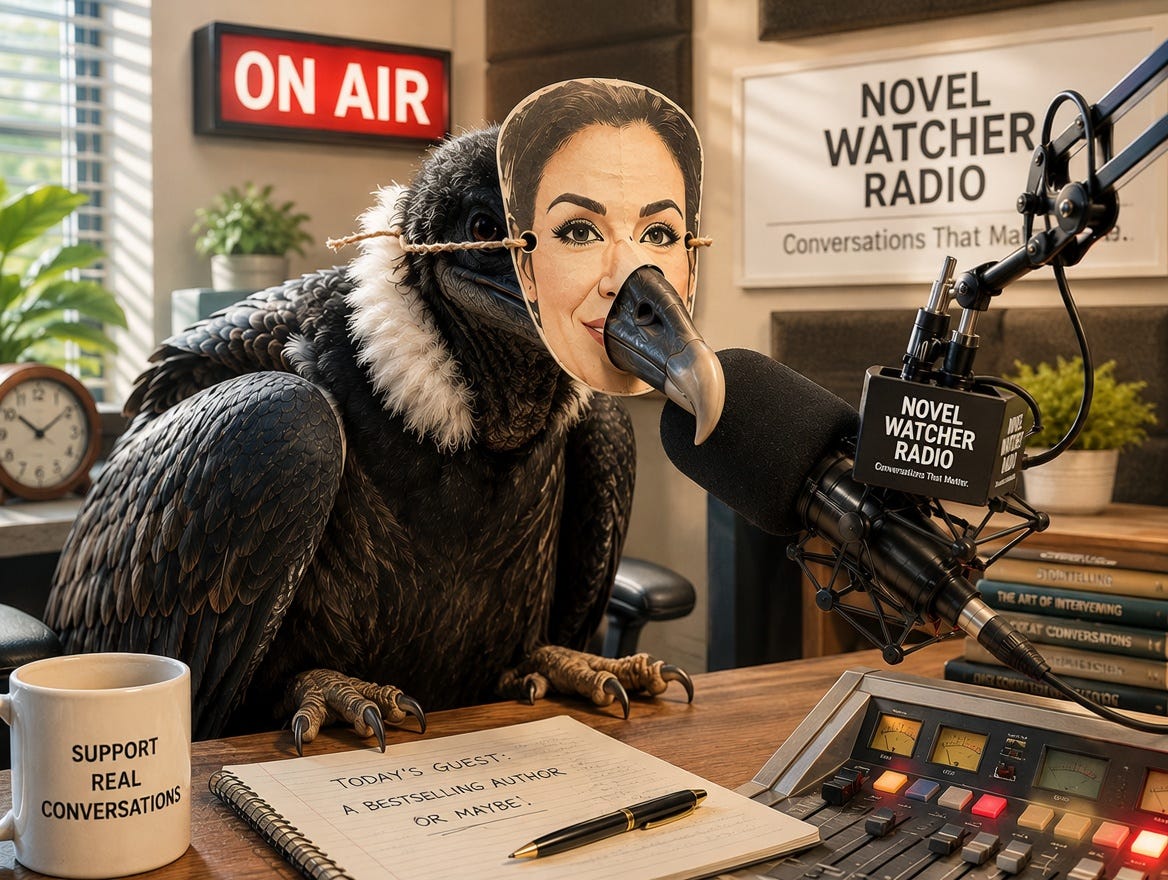
“Book vulture (noun): in the terminology of Central European writer Peter Radley, this term refers to the email-based scammers who present themselves as professional book marketing experts and approach — usually independent — authors with offers of practically nonexistent services in exchange for smaller or larger sums of money, always payable in advance. An integral part of Radley’s body of work is the almost sensual pleasure with which, in his replies, he annoys these poor bastards to death.”
(Kate Marlowe: A Practical Guide to Surviving Peter Radley — excerpt)
Lately, book vultures have developed a fondness for approaching me with their nonsense under the names of well-known radio personalities. It took me a whole five minutes to figure out why they came up with this method.
Previously, the fashion was to write to me disguised as book marketing experts and offer to send me a free evaluation of my books’ marketing statistics. I never asked any of them for such a thing — but of course, some sent one anyway. So I can say with complete confidence: those materials are very weak. Usually, AI throws together some utterly generic text — the kind a chimpanzee sitting in front of a typewriter could outperform. And in return, the chimp would be satisfied with three bananas instead of demanding a bank transfer.
Well, it seems that the more educated book vultures have realized that by dressing up as radio hosts, they have to do even less for the hoped-for success. After all, they only need to send a link to one of the real radio person’s actual shows, and the trap is complete.
Let me show you an example. (As a preliminary note: I should mention that in the correspondence below, I have changed the names of the journalist and the radio station involved. This was at their request, as they felt it would not reflect well on them if they were even mentioned in connection with such a brazen scam attempt. It was a completely reasonable request—I didn’t argue with it for a moment.)
Dear Peter,
I’m Sylvia Horn, host of Novel Watcher Radio, a platform where we have thoughtful, in-depth conversations with authors about the ideas behind their work.
I’d love to invite you to feature your book on the show. We focus on meaningful discussions that help authors connect with a genuinely engaged audience, not just quick promotion.
Our listeners are people who care about books, ideas, and the stories behind them, so it’s a great opportunity to expand your reach and build deeper interest in your work.
If this sounds like something you’d be open to, just reply “interested” and I’ll share the details.
Best,
Sylvia Horn
Host, Novel Watcher Radio
For one brief moment, I almost felt touched. Then I noticed that ”Sylvia Horn” had somehow failed to mention either the title of my book or any convincing evidence that she had ever seen a book at close range.
Okay. This is not how it works. An invitation to appear on a radio show does not arrive like this. This is nothing more than a cold email — and the person who wrote it did not even bother to include the title of my book. And when they do include it, it only takes about two extra minutes to discover that they have no idea what you wrote. They copy three lines from the blurb they found on Amazon and assume that this will make you believe they have read your work. It is fucking exhausting, by the way.
I should add that Novel Watcher Radio really does exist, and so does Sylvia Horn. She really does produce shows about books and authors — but you can be quite certain that she does not send out invitations by hand from Gmail accounts.
For cases like this, I have developed two coping strategies. One is to write to the real person and let them know about the scam — and inform the esteemed scammer that I have done so. The other, which I use when I am simply too tired for these idiots, is to reply with some one-line brush-off.
In this case, I chose the latter.
I never give interviews. Everything I want to say is in my books.
I do not know Sylvia Horn, but I am fairly certain that she would have replied with something like, “I understand, thank you” — and I would never have heard from her again. Because that is the professional response. Let me go further: that is the normal response.
My correspondent, naturally, did no such thing. Instead, she surprised me with a sea of text that appeared, at first glance, to be remarkably well put together. The original was much longer and much more exhausting, but I hope you will forgive me for not burdening you with the whole thing.
Thank you for your response, and I completely respect your position.
Many authors feel that their books already contain the message they want readers to receive. Because of that, Novel Watcher Radio does not require live interviews or public appearances. Our features are designed to spotlight the book itself while allowing the author to decide how involved they wish to be.
In your case, participation would not require a live interview. We would handle the structure, editorial development, and audience-facing presentation based on your work and any material you choose to share with us.
The one-time $300 onboarding and registration fee covers:— Editorial preparation and feature development
— Programming and scheduling placement
— Production coordination and content formatting
— Promotional distribution across our listener network
— Platform management and publication support
— Audience engagement handling and administration
— Long-term archive placement on the platform
— Technical processing and campaign coordinationThis allows us to give each author individual attention.
If you would like to move forward, simply reply “Proceed,” and I will send over the onboarding steps and scheduling information.
Now this is dangerous. Because the text really does seem fairly professional — apart from two small, rather significant details.
The first is that Novel Watcher Radio — I know, because I checked — never charges authors money to appear on its shows. Let me repeat that: never. The second is that I myself had the pleasure of working in radio for a few years, and let me tell you: the services listed in exchange for that $300 are not extras. They are the job of a radio show’s editor. If they had offered me a velvet-couch dressing room, liveried footmen, and Dom Pérignon champagne, then all right, maybe the $300 would have made sense — but you do not need any of those things for an interview.
In any case, the matter still had not become interesting enough to deserve much of my time, so I tried another short reply.
So if I send you $500 right now, we’re all good?
Let’s cut the nonsense.
“Sylvia,” unfortunately, proved persistent. She still believed she had a chance of hunting me down. This was a mistake, though she did not yet know that when she sent the following email.
I understand your concern, and I assure you this is not nonsense.
The onboarding requirement is simply part of our registration and scheduling process for all featured authors.
Kindly complete it through this link below:
[here there was a link which I would not recommend opening under any circumstances]
Once payment has been completed, kindly send the payment screenshot or confirmation receipt here so we can verify it and immediately proceed with your onboarding and feature scheduling.
Looking forward to working with you and featuring your book on Novel Watcher Radio.
No. It was nonsense. Sadly.
But I did not get a chance to inform the excellent professional of this, because work came crashing down on my head, and for two days I did not even look at my inbox.
“Sylvia” apparently did not take this well, because she sent another email.
Four times in a row. Once an hour.
Dear Peter,
I hope you’re doing well.
I just wanted to follow up regarding your Novel Watcher Radio feature registration. At the moment, the onboarding payment is the only thing pending for us to finalize your placement and move forward with scheduling your feature.
Once completed, kindly send the payment screenshot or confirmation receipt so we can verify it and proceed immediately.
Your participation truly means a lot to us, and we look forward to featuring your work on Novel Watcher Radio.
At this point, the lady began to annoy me. I mean, if it was a lady at all, because for all I know, I may have been corresponding with a six-foot-six bald gangster — one of the many beauties of the digital world, naturally.
So I continued to keep my answer short, though it is true that my usual young-lady manners slightly deserted me at this stage.
Are you stupid, or what is wrong with you?
I made it clear I wasn’t interested.
I must confess, I have used the above turn of phrase before to bring conversations to a close — usually with success. But not this time.
“Sylvia” replied. In fact, if I understood her words correctly, she even felt a little hurt.
The only stupid thing here is the way you chose to respond to such a promising opportunity.
No one is forcing you to participate. This was simply a professional opportunity being offered to you. If you were not interested, you could have said so respectfully instead of behaving this way.
Basic courtesy costs nothing.
So I will ask you again: should I send over the link to finalize your slot?
Or, to put it another way: “Mr. Radley, while it is beyond dispute that you have just shot the groom, we sincerely hope this will not prevent you from taking his place at the altar.”
Any self-respecting journalist, after receiving such a rude email — mine, I mean — would have cut off all contact with me for good. My correspondent, however, seemed to have placed me quite seriously in her crosshairs.
Besides, I had to admit that she was right: one must treat a book vulture with respect. We would not want the poor little soul to be hurt while spending my $300.
And so I gathered every last ounce of my baroque sentence-building ability in order to write this.
Dear Ms. Horn,
Allow me, first of all, to express my sincere admiration for the noble and undeniably demanding world of literary broadcasting — a profession which, I have no doubt, has brought inspiration, visibility, and perhaps even a measure of well-deserved vanity to countless authors fortunate enough to find themselves welcomed beneath its generous spotlight.
I can easily imagine that for many writers, an invitation from such a platform might represent not merely a promotional opportunity, but something approaching a small professional coronation — an affirming moment in which one’s words, ideas, and the flourishing branches of one’s carefully cultivated public identity are offered yet another stage upon which to perform.
Sadly, I must confess that I belong to a rather different species.
I have always preferred the quiet company of pages to the persistent company of invitations, reminders, follow-ups, payment links, additional reminders, and the increasingly determined resurrection of conversations I believed had already been laid peacefully to rest.
As a man who values silence almost as much as sanity, I have therefore reached the unavoidable conclusion that, for the continued preservation of both, I must decline your generous offer once and for all.
Finally, after long consideration, my decision has been made.
And with the greatest respect, warmest gratitude, and the most sincere wishes for the continued success of your undoubtedly admirable enterprise, I respectfully ask you —
please fuck off.
“Sylvia” did not keep me waiting long for her reply. And it seemed that my baroque elegance had caught somewhat in her throat, because this time she was the one who wrote a short answer.
Namely this:
Fuck you if you are incapable of communicating with people properly.
See? Some people are impossible to please. If you write briefly, that is the problem. If you write in beautifully crafted prose, that is the problem too. And she was the one who had asked me to be respectful, which I had achieved — almost.
For the sake of completeness, I should mention that the real Sylvia Horn is not only an excellent interviewer, but also a trained coach. Which means that even if, during her show, live on the air, you gave unmistakable signs of being clinically insane, she would still get through the entire broadcast without raising her voice. In other words, I would not have been able to unhinge her this easily.
As a farewell, I wrote one final email to “Sylvia.” It said only this:
I am a writer, not a psychiatrist. But look on the bright side: at least now you do not have to explain why you are sending me scam emails demanding money while hiding behind the real Sylvia Horn’s identity.
“Sylvia” disappeared. There is no lesson. Only, perhaps, the reminder that real professionals still exist.
Because there is a postscript. I briefly described the story to Sylvia Horn’s team — and they replied. They apologized for the inconvenience caused by the scammer.
Hm. This is a different level.